

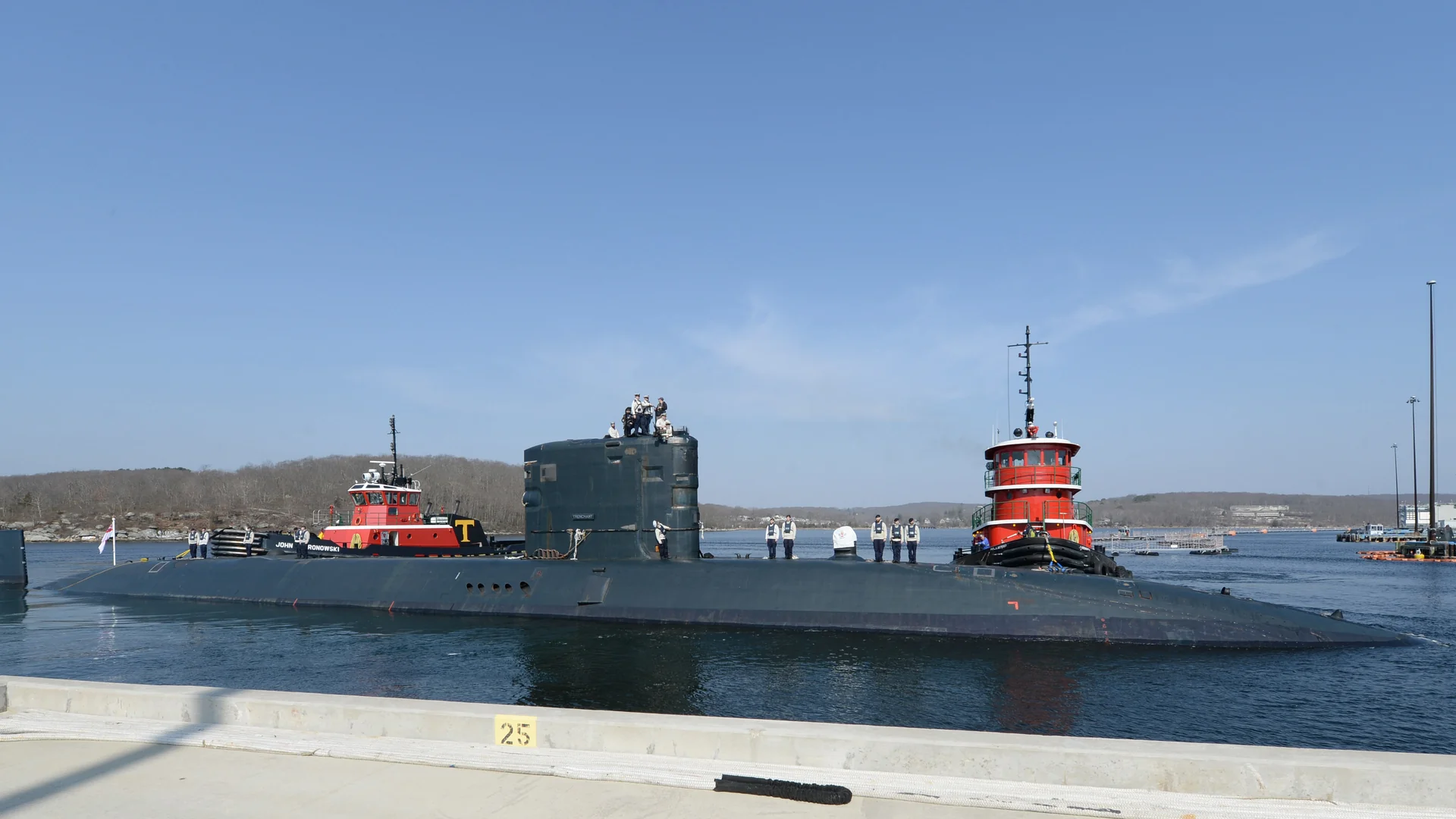
Photo: US Navy, MC1 Steven Hoskins (public domain) Source

Pennant: S91
Motto: Not Known
Built By: Vickers Shipbuilding and Engineering Ltd (VSEL)
Built Where: Barrow-in-Furness
Laid Down: 28 Oct 1985
Launched: 3 Nov 1986 by Lady Meriel Hunt)
Commissioned: 14 Jan 1989
Decommissioned: 20th May 2022
Fate: Laid up at Devonport, awaiting defuelling and dismantling
Her Service
HMS Trenchant
Her Stories
A Trafalgar-class submarine of the Royal Navy
Short History
HMS Trenchant (S91), fifth of the class, was named for the wartime T-class submarine in which Commander Arthur Hezlet sank the Japanese cruiser Ashigara in 1945. Ordered on 22nd March 1983 and laid down at Barrow on 28th October 1985, she was launched on 3rd November 1986 by Lady Meriel Hunt, wife of Admiral Sir Nicholas Hunt, Commander-in-Chief Fleet, with Vice Admiral Sir Arthur Hezlet looking on, and commissioned on 14th January 1989. Her badge, a sword erect, dates from January 1945.
The Loss of Antares, 1990
Less than two years into her career she was involved in the worst peacetime tragedy of the class. In the early hours of 22nd November 1990, at the end of a Perisher command-course exercise in Bute Sound, north-east of Arran, Trenchant snagged the trawl of the Carradale fishing boat Antares and dragged her under. All four of her crew died.
The Boat's first report that the trawler was safe delayed the search.
A Fatal Accident Inquiry in 1991 found the sinking 'was caused by human error on board HMS Trenchant', and the Marine Accident Investigation Branch, reporting in July 1992, blamed a partial breakdown in watchkeeping structure and standards; the Ministry of Defence accepted full responsibility, the Duty Commander, Lieutenant Commander Peter McDonnell, was convicted of negligence at a court martial in June 1992 and severely reprimanded, and the minimum separation between dived submarines and fishing vessels was raised first to 3,000 and then to 4,000 yards.
The raised wreck was displayed at the Scottish Maritime Museum until 2008 and a memorial plaque stands in Carradale harbour wall. (Hansard Entry) (Hansard Entry) (Hansard Entry)
Long Patrols
Trenchant went on to a long and varied career from Devonport. In July 1997, approaching Fremantle in Western Australia at about 200 metres, she grounded on the continental shelf but freed herself with no significant damage.
In 1998 a steam leak is reported to have forced a reactor shutdown; the same year she trialled a non-hull-penetrating optronic mast and a pale-blue disruptive paint scheme. On 21st June 2007, in the Gulf of Mexico, she became the first Royal Navy vessel to fire the Tomahawk Block IV missile. A two-year refit at Devonport ended with her rededication on 6th June 2011. (Hansard Entry)
Sailing on 22nd June 2012 under Commander Irvine Lindsay, she completed the longest patrol ever by a Royal Navy fleet submarine, returning to Devonport on 22nd May 2013 after 335 days away, 267 of them east of Suez, 38,800 nautical miles and more than 4,700 hours dived, with calls at Fujairah, Diego Garcia, Bahrain, Aqaba, Souda Bay and Gibraltar. After the largest maintenance period then undertaken at Devonport, some 650,000 man-hours, she was rededicated in August 2016 with Lady Hunt present.
In March 2018, under Commander David Burrell, she surfaced through the Arctic ice north of Alaska alongside USS Connecticut and USS Hartford in ICEX 2018, the first British participation since Tireless's fatal 2007 exercise, and her crew held a memorial service on the ice for Paul McCann and Anthony Huntrod.
The Last Years
Her final years were not without controversy. In April 2020, alongside at Devonport with the crew isolating aboard during the Covid lockdown, a barbecue party with a DJ set was filmed and posted online; the Commanding Officer, Commander Jonathan Lewis, was removed from command.
Her last four-month Atlantic deployment was filmed for the Channel 5 series Submarine: Life Under the Waves, broadcast in September 2021. Trenchant entered Plymouth for the last time on 25th March 2021 flying her decommissioning pennant and was formally decommissioned at Devonport on 20th May 2022, in a joint ceremony with HMS Talent attended by the Princess Royal, Commander Gareth Batsford being named as her captain.
Trenchant now lies afloat at Devonport. All seven decommissioned T-Boats lie afloat at Devonport awaiting defuelling and dismantling under the Submarine Dismantling Project; defuelling has not taken place there since 2004, when it stopped on safety grounds. In June 2025 Babcock won a £114 million contract to prepare four Boats for defuelling, beginning with a Trafalgar class submarine from 2026, but no report that work has begun, or which Boat is first, was found by October 2026. Full dismantling is expected to run into the 2040s.
Badge and Name
About HMS Trenchant's Badge
Trenchant means sharp and cutting, a word first used of a blade with a keen edge and a sharp point. So the badge is a sword, standing upright in its natural colours.
Behind the sword the field is split diagonally into four. The top and bottom quarters are red, and the two side quarters are the sea, six wavy bars of white and blue.
The design was approved in 1945 for the wartime T-Boat Trenchant, and our Trenchant carried it on. There's no recorded motto.
The Name Trenchant
Three ships have carried the name.
HMS Trenchant (G96 / G78) · Modified R-Class Destroyer · 1916 to 1928 · Sold for Scrap
Built by J. Samuel White at Cowes and launched on 23rd December 1916, she joined the Grand Fleet in 1917 and spent the rest of the war on anti-submarine patrols and convoy escort. She was sold for scrap in 1928.
HMS Trenchant (P331) · T-Class Submarine · 1943 to 1963 · Broken Up at Faslane
Built at Chatham and launched on 24th March 1943, she went to the Far East under Cdr Hezlet. On 23rd September 1944 she torpedoed and sank the German U-Boat U-859 off Penang in the Strait of Malacca.
On 8th June 1945, in the Bangka Strait, she sank the Japanese heavy cruiser Ashigara. She earned the battle honour Malaya 1944 to 1945. She was sold for scrap on 1st July 1963 and broken up at Faslane.
HMS Trenchant (S91) · Trafalgar-Class Submarine · 1989 to 2022 · Laid Up at Devonport
Our Trenchant is the third of the name, and she served the Submarine Service for over thirty years before paying off on 20th May 2022.
Publicly Known Incidents
Verified Incidents Involving HMS Trenchant
22 November 1990
Snagged the Trawl of FV Antares, Which Sank with All Four Crew
At about 02:17 on 22nd November 1990, during the final sea phase of a Perisher command course, Trenchant snagged the trawl of the Carradale fishing vessel Antares and dragged her under; all four of her crew were lost. Trenchant's first report that the trawler was safe delayed the search until about 11:00; the wreck was raised on 10th December 1990 and the last body was recovered in April 1991.
A Fatal Accident Inquiry (determination 22nd October 1991) found the accident 'was caused by human error on board HMS Trenchant', the Royal Navy Board of Inquiry found 'procedural and personal failings', and the MAIB report of July 1992 attributed it to a partial breakdown in watchkeeping structure and standards; the Ministry of Defence accepted full liability.
Minimum separation from fishing vessels was raised to 3,000 and then 4,000 yards, VHF sets and net-pinger trials were introduced, and the wreck was later displayed at the Scottish Maritime Museum until broken up in 2008. (Hansard Entry) (Hansard Entry) (Hansard Entry) (Hansard Entry) (Hansard Entry) (Hansard Entry) (Hansard Entry)
June 1992
Court Martial of the Duty Commander Over the Antares Sinking
Lt Cdr McDonnell, Trenchant's Duty Commander on the night of the sinking, was court-martialled in June 1992; the trial had taken place by 11th June 1992, with the verdict subject to review by the Commander-in-Chief Fleet. He faced six counts of negligence, was convicted on three and was severely reprimanded. The Armed Forces Minister declined further disciplinary action in October 1992, to criticism from the families. (Hansard Entry) (Hansard Entry) (Hansard Entry)
July 1997
Dived Grounding on the Continental Shelf off Fremantle
In July 1997, approaching Fremantle at about 200 metres, Trenchant grounded on a sloping patch of the continental shelf, freed herself, and divers found no significant damage. The grounding is in the Ministry of Defence's official list of submarine collisions and groundings. (Hansard Entry) (Hansard Entry)
April 2020
Lockdown Party Alongside at Devonport and Commanding Officer Removed
In April 2020, while Trenchant was alongside at Devonport for repairs with her crew isolating aboard under the Covid lockdown, a barbecue party with an impromptu DJ set was filmed and posted on social media. The Commanding Officer, Cdr Lewis, reportedly approved the event despite advice against it. The Royal Navy opened an investigation, sent him home and on 29th April 2020 confirmed he had been removed from command.
Unconfirmed Reported Incidents
1998
Steam Leak Forcing a Reactor Shutdown
In 1998 a steam leak is reported to have forced the crew to shut down the reactor. No official or press account of it has been found.
Souls Lost
22 November 1990
The Fishing Vessel Antares
While dived on a training exercise in the Firth of Clyde, HMS Trenchant snagged the nets of the Carradale fishing vessel Antares, which was pulled under and sank. Her four fishermen lost their lives. A Fatal Accident Inquiry found the accident was caused by human error on board Trenchant, and the Ministry of Defence accepted full liability. The rules for keeping submarines clear of fishing vessels were tightened as a result.
0 Comments