

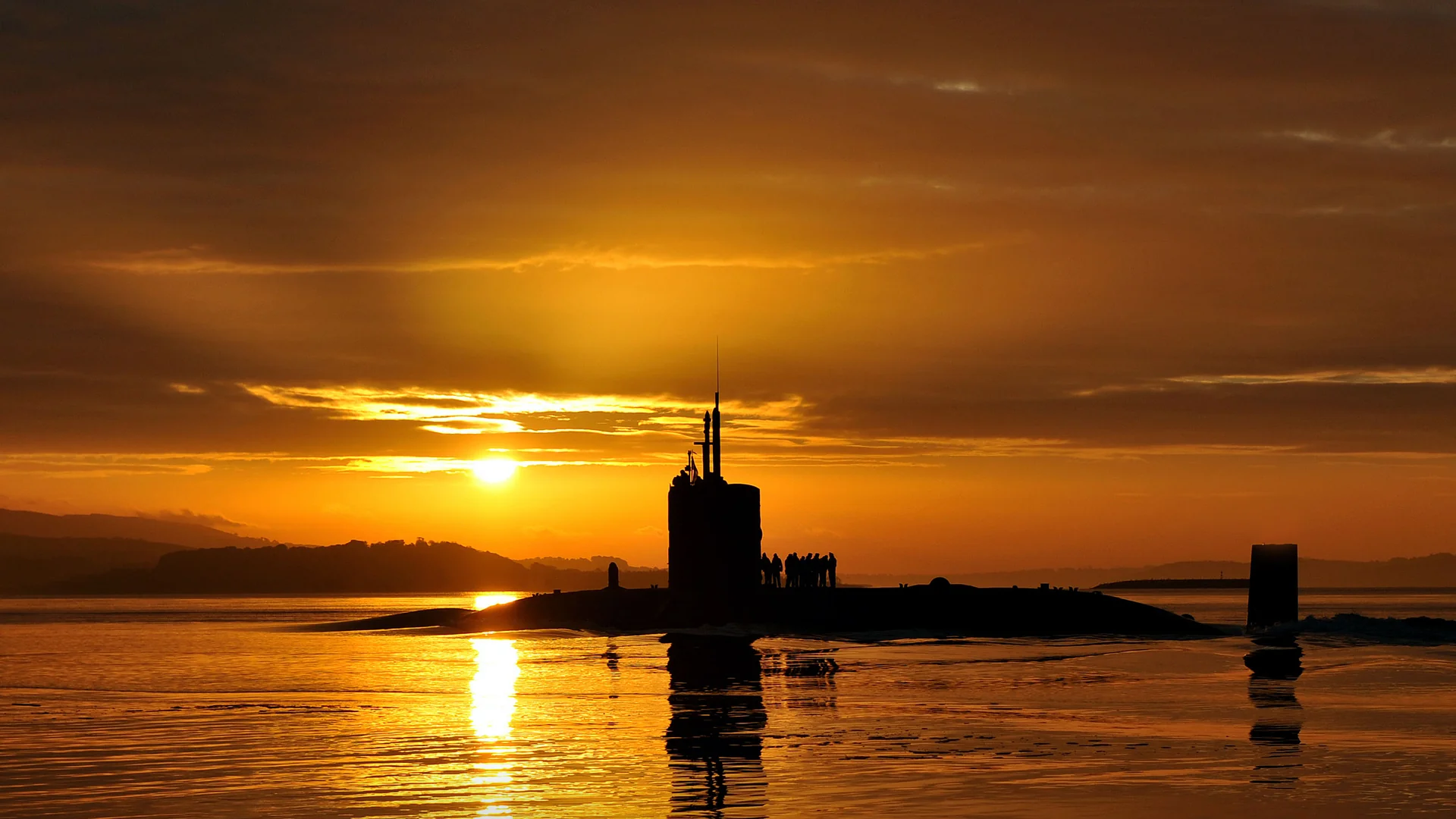
Photo: LA(Phot) Ben Sutton / MOD, Open Government Licence v1.0, via Wikimedia Commons

Pennant: S93
Motto: We Shall Triumph
Built By: Vickers Shipbuilding and Engineering Ltd (VSEL)
Built Where: Barrow-in-Furness
Laid Down: 2 Feb 1987
Launched: 16 Feb 1991 by Mrs Ann Hamilton
Commissioned: 12 Oct 1991
Decommissioned: Jul 2025
Fate: Out of service at Devonport, being prepared for storage afloat, then disposal
Her Service
HMS Triumph
Her Stories
A Trafalgar-class submarine of the Royal Navy
Short History
HMS Triumph (S93) was the seventh and last Trafalgar class submarine and the tenth Royal Navy ship to carry a name whose battle honours run from the Armada of 1588 to Korea in 1950. Ordered on 3rd July 1986 and laid down at Barrow on 2nd February 1987, she was launched on 16th February 1991 by Mrs Ann Hamilton, wife of the Armed Forces Minister Archie Hamilton, and commissioned in October 1991.
Her motto is 'We shall triumph' and her badge a laurel wreath, the reward of a victorious Roman commander.
She made her mark early. In 1993 she sailed to Australia and back, 41,000 miles dived without forward support, then the longest solo deployment by a British nuclear submarine. On 19th November 2000, dived at 22 knots under trainee officers off the west of Scotland, she made 'glancing contact with soft sand and shells on a shelving seabed'; the damage was superficial and cost about £6,000 to repair, but a Board of Inquiry blamed poor navigation and two lieutenants were referred for court martial. (Hansard Entry) (Hansard Entry)
Afghanistan, 2001
In October 2001 Triumph was one of three British submarines in the Arabian Sea at the opening of the Afghanistan campaign and fired Tomahawk missiles at Taliban targets during Operation Veritas, flying the Jolly Roger on her return. A £300 million refit and refuel at Devonport from 2005 gave her the Sonar 2076 suite and new command systems; she rejoined the fleet in June 2010.
Libya, 2011
Her second war came in 2011. During Operation Ellamy she fired Tomahawks at Libyan air-defence targets on 19, 20 and 24th March, one strike hitting a command centre in Colonel Gaddafi's compound, and returned to Devonport on 3rd April flying a Jolly Roger with six tomahawk symbols. Relieved in the Gulf of Sidra by HMS Turbulent, she went back for a second patrol and came home on 20th June with further markings; analysts put her total at more than 15 missiles.
She then sailed in November 2011 on a seven-month deployment east of Suez. The class's combat record of three campaigns, Afghanistan, Iraq and Libya, thus began and ended with Triumph alongside her sisters.
The Last Years
A refit at Faslane from November 2014 was followed by a return to the front line in September 2016. She entered a four-year revalidation period at Devonport in December 2018, emerging in December 2022 for a service life extended by the 2021 Integrated Review to 2025.
On 10th December 2024 she left Faslane for the last time, bound for Devonport, and in July 2025 she was decommissioned at HMS Drake in a joint parade with Talent's crew, with Lady Hamilton as guest of honour, Second World War submariner John Harlow among the guests and Captain Dave Burrell, once Executive Officer of both Talent and Triumph, taking the salute.
After 34 years, the longest career of the seven, she was the last T-Boat in service, closing more than 200 years of collective class service; her duties pass to HMS Achilles, the final Astute class Boat, later this decade.
As of October 2026 Triumph is out of service at Devonport, where she was expected to spend up to two years with a skeleton crew being prepared for long-term afloat storage before joining her six sisters in 3 Basin. All seven decommissioned T-Boats lie afloat at Devonport awaiting defuelling and dismantling under the Submarine Dismantling Project; defuelling has not taken place there since 2004, when it stopped on safety grounds.
In June 2025 Babcock won a £114 million contract to prepare four Boats for defuelling, beginning with a Trafalgar class submarine from 2026, but no report that work has begun, or which Boat is first, was found by October 2026. Full dismantling is expected to run into the 2040s.
Badge and Name
About HMS Triumph's Badge
Triumph's badge is a simple one. It's a wreath of green laurel on a white field, the reward given to a victorious Roman leader.
The design was approved in 1938 for the T-Boat Triumph, and our Triumph carried it on. The motto is in plain English, We Shall Triumph.
The Name Triumph
Ten ships have carried the name, and an eleventh was renamed before she was launched.
Triumph · Galleon · 1562 to 1618 · Condemned
Built at Deptford and launched in 1562, she was Martin Frobisher's flagship against the Spanish Armada in 1588. She was rebuilt in the 1590s and condemned in 1618.
Triumph · 42-Gun Ship · 1623 to 1680s · Sold
Built at Deptford in 1623, she was the Duke of Buckingham's flagship at La Rochelle in 1627. In the First Dutch War she fought at Dover, Kentish Knock, Portland, the Gabbard and Scheveningen, by then carrying 60 guns. She was sold out of the Navy in the late 1680s.
HMS Triumph · 90-Gun Second Rate · 1698 to 1773 · Broken Up
Built at Chatham and launched in 1698, she was renamed Prince in 1714, rebuilt in 1750 and broken up in 1773.
HMS Triumph · 18-Gun Sloop · 1739 to 1740 · Foundered
She was a Spanish sloop, the San Cristóbal, captured in 1739 and taken into the Navy as Triumph. She foundered the following year.
HMS Triumph · 74-Gun Third Rate · 1764 to 1850 · Broken Up
Built at Woolwich and launched on 3rd March 1764, she fought at Camperdown in 1797. She went into harbour service in 1813 and was broken up in 1850.
Triumph · 91-Gun Screw Second Rate · Renamed 1862 · Launched as HMS Prince Consort
Ordered from Pembroke Dockyard in 1857 as Triumph, she was renamed Prince Consort on 14th February 1862, after the death of Prince Albert, and launched that June as an ironclad.
HMS Triumph · Swiftsure-Class Ironclad · 1870 to 1921 · Sold for Scrap
Built by Palmers at Jarrow and launched on 27th September 1870, she served several spells as flagship on the Pacific Station. She became a depot ship in 1901 and was renamed Tenedos in 1904 to free the name, then Indus IV and finally Algiers. She was sold for scrap in 1921.
HMS Triumph · Swiftsure-Class Battleship · 1903 to 1915 · Sunk off Gaba Tepe
Built at Barrow for Chile as Libertad, she was bought by Britain in 1903. She fought against the German colony at Tsingtao in 1914 and then went to the Dardanelles.
On 25th May 1915, while bombarding Turkish positions off Gaba Tepe, she was torpedoed and sunk by the German U-Boat U-21.
HMS Triumph (N18) · T-Class Submarine · 1938 to 1942 · Lost in the Aegean
Built by Vickers Armstrong at Barrow and launched on 16th February 1938, she patrolled the Mediterranean from early 1941 and sank the Italian submarine Salpa that June. On 30th December 1941 she landed agents on Antiparos in occupied Greece.
She failed to make the pickup on 9th January 1942 and nothing more was heard from her. She was probably mined. All 64 of her crew were lost. Her wreck was found off Cape Sounion in 2023.
HMS Triumph (R16 / A108) · Colossus-Class Aircraft Carrier · 1944 to 1981 · Sold for Scrap
Built by Hawthorn Leslie on the Tyne and launched in 1944, she flew the first carrier strikes of the Korean War on 3rd July 1950. She was later converted to a heavy repair ship and was sold for scrap in 1981.
HMS Triumph (S93) · Trafalgar-Class Submarine · 1991 to 2025 · Out of Service at Devonport
Our Triumph is the tenth ship to carry the name. She paid off in July 2025 after more than thirty years in commission.
Publicly Known Incidents
Verified Incidents Involving HMS Triumph
19 November 2000
Dived Grounding off the West Coast of Scotland During Officer Training
On Sunday 19th November 2000, dived at 22 knots and under the control of trainee officers, Triumph made 'glancing contact with soft sand and shells on a shelving seabed', surfaced safely and proceeded to Faslane as programmed; neither Boat nor crew was at risk. The superficial damage was repaired in January 2001 for about £6,000.
A Board of Inquiry convened on 21st November 2000 attributed the grounding to poor navigation, and the Naval Prosecuting Authority referred Lieutenants Ian Tabberer and Ashley Philpott for court martial; the outcome has not been found. (Hansard Entry) (Hansard Entry) (Hansard Entry) (Hansard Entry)
Unconfirmed Reported Incidents
None recorded.
Souls Lost
25 May 1994
Petty Officer Weapon Engineering Artificer Andrew John Donnelly
Died in Service (cause not recorded).
5 September 2013
Engineering Technician (Marine Engineering Submarines) Christopher Payne
Died in Service (ashore). Road accident, Holbrook, Derbyshire.
0 Comments