
HMS Dolphin
The alma mater of the Submarine Service: Fort Blockhouse, Gosport, 1904 - 1998.
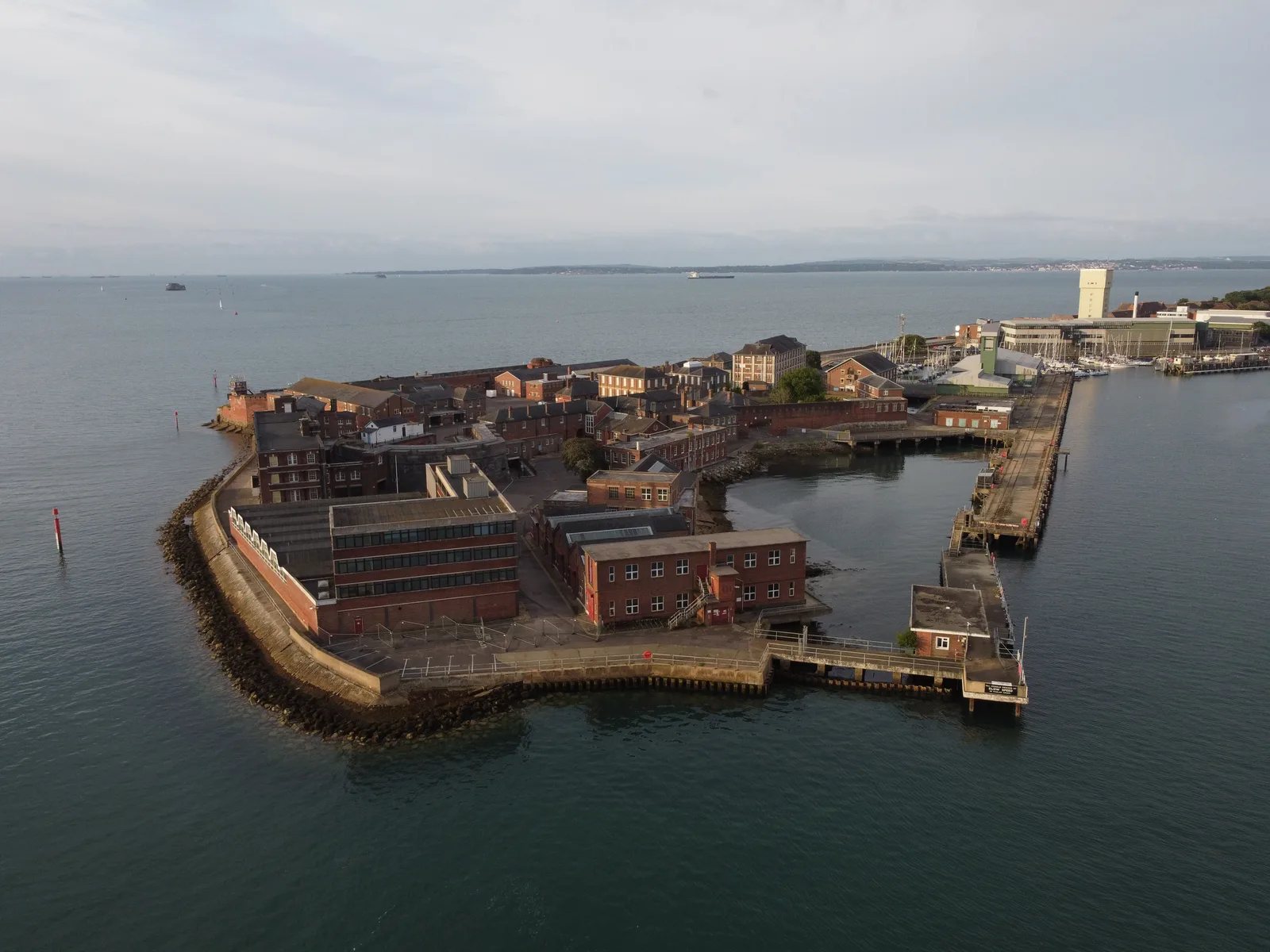 Fort Blockhouse, the former HMS Dolphin, Gosport, 2025.
Photo: Tim Sheerman-Chase, CC BY 4.0, via Wikimedia Commons.

Short on time? Brief version here …
HMS Dolphin, at Fort Blockhouse in Gosport, was the home of the Royal Navy's Submarine Service from 1904 - 1905: its base, its school and its escape training tank. The last operational submarines sailed from Dolphin in 1993, HMS Dolphin was decommissioned in 1998 and the Submarine School left at the end of 1999. Escape training in the tank went on until January 2020, and the Ministry of Defence has tried to sell the site since 2016. Empty since December 2021, the place where generations of submariners learned their trade is falling into disrepair.
- 1417: a blockhouse guards the mouth of Portsmouth Harbour.
- 1709: the fort is rebuilt; Queen Anne's cypher is still on the gatehouse datestone.
- 1902: the first submarine flotilla forms at Portsmouth.
- 1904 - 1905: the Royal Navy moves its submarines into Fort Blockhouse.
- 1912: the Portsmouth Boats become the Second Submarine Flotilla, and on 31st August the base becomes HMS Dolphin.
- 1917: the Periscope School opens, and the Submarine Memorial Chapel is built.
- 1932 - 1961: home of the 5th Submarine Flotilla, called the 5th Submarine Squadron by 1954.
- 13th July 1954: the first ascent in the 100-foot Submarine Escape Training Tank.
- 1961: the 5th Submarine Squadron becomes the 1st Submarine Squadron (SM1).
- 7th July 1961: the Submarine Branch is granted the Freedom of the Borough of Gosport.
- 1978: Flag Officer Submarines moves his headquarters from Dolphin to Northwood.
- 30th September 1993: SM1 leaves Gosport, ending some ninety years of submarines sailing from Dolphin; it forms again at Faslane the next day.
- 30th September 1998: HMS Dolphin is decommissioned.
- 23rd December 1999: the Submarine School leaves for HMS Raleigh.
- 2016: the Ministry of Defence lists Fort Blockhouse for disposal.
- January 2020: the escape tank closes.
- December 2021: the last military unit leaves.
- Today: empty, unsold, its buildings in poor condition, and not on the Heritage at Risk Register.
For most of the twentieth century, Royal Navy submariners started in the same place. HMS Dolphin, at Fort Blockhouse on the Gosport side of the mouth of Portsmouth Harbour, was the home of the Submarine Service from its first years. It was the Service's base, its school and, until 1978, its headquarters. The last operational submarines sailed from Dolphin in 1993, HMS Dolphin was decommissioned in 1998, and the Submarine School stayed until the end of 1999. For generations of submariners it was simply "Blockhouse" or "Dolphin": the alma mater of the Submarine Service.
Men learned the basics of their trade here. They sat their courses in the Submarine School, practised attacks in the attack teacher, and made the ascent from the bottom of the 100-foot escape tank. Boats sailed from the jetties for the two World Wars and for most of the Cold War.
The site was old long before the submarines came. A blockhouse stood on this spit of land by 1417, and the fort that grew from it is a scheduled monument. Nine of its buildings and structures are listed, among them the Submarine Escape Training Tank, the Submarine Memorial Chapel of St Nicholas and the Submariners' Memorial.
The Submarine School left at the end of 1999, and the Navy's escape training team followed in January 2020. The Ministry of Defence put Fort Blockhouse up for disposal in 2016, and it has stood empty since the last military unit left in December 2021. Ten years on, it has not been sold. Its buildings are officially described as in poor condition and beyond their design life. The escape tank, closed since January 2020, needs an estimated £11 million of repairs. Even so, none of the site's buildings is on Historic England's Heritage at Risk Register.
We know of no place that means more to the Royal Navy Submarine Service.
Since the Navy left, it has been allowed to decay. This is Dolphin's story, from the first blockhouse to the present day.
The Fort Before the Submarines
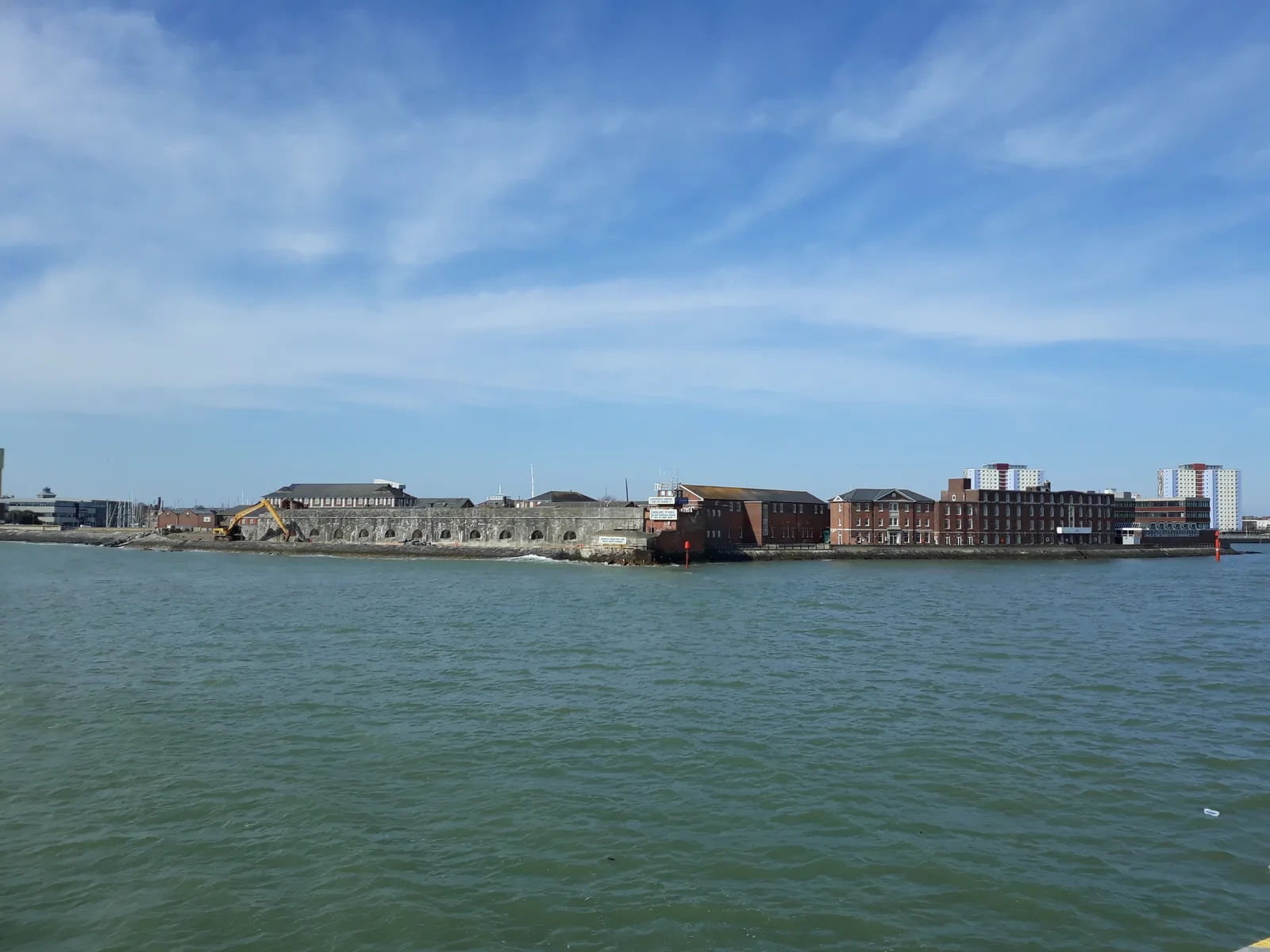 Fort Blockhouse and its old stone walls, seen across the water, 2020.
Photo: Simon Burchell, CC BY-SA 4.0, via Wikimedia Commons.

A blockhouse, a fortified tower, stood on the Gosport shore of the harbour mouth by 1417. A chain ran from it across the water to the Round Tower on the Portsmouth side, so the entrance could be closed against enemy ships. Nobody now knows exactly where the medieval tower stood within the later fort.
A new bulwark was built about 1538, in the reign of Henry VIII, but by the end of the sixteenth century the defences were derelict. In the late 1660s Sir Bernard de Gomme, the King's engineer, strengthened Portsmouth's defences, and by 1674 a battery for 21 guns stood on the point, nearly all facing south.
The fort was rebuilt about 1709, with a moat, a gatehouse and a sea battery of thirteen 32-pounder guns. The gatehouse datestone, carved with "ANNO 1709" and Queen Anne's royal cypher, survives and is listed. In 1777 the body of James Aitken, "John the Painter", who had set fire to Portsmouth Dockyard, was hung in chains at Fort Blockhouse for several years.
The Napoleonic Wars brought more work, and the gate was remodelled in 1813. Between 1845 and 1848 the sea battery was strengthened, the stone North Bastion was built, and two blocks of bombproof quarters were added: casemates for officers, now Thames Block (its datestone reads 1847), and quarters for soldiers, now Arrogant Block. Both are listed.
In 1873 the Royal Engineers took over the fort to lay and control the harbour's defensive minefields. The men who did it were called submarine miners. Thirty years later the name would mean something quite different here.
The Submarines Arrive
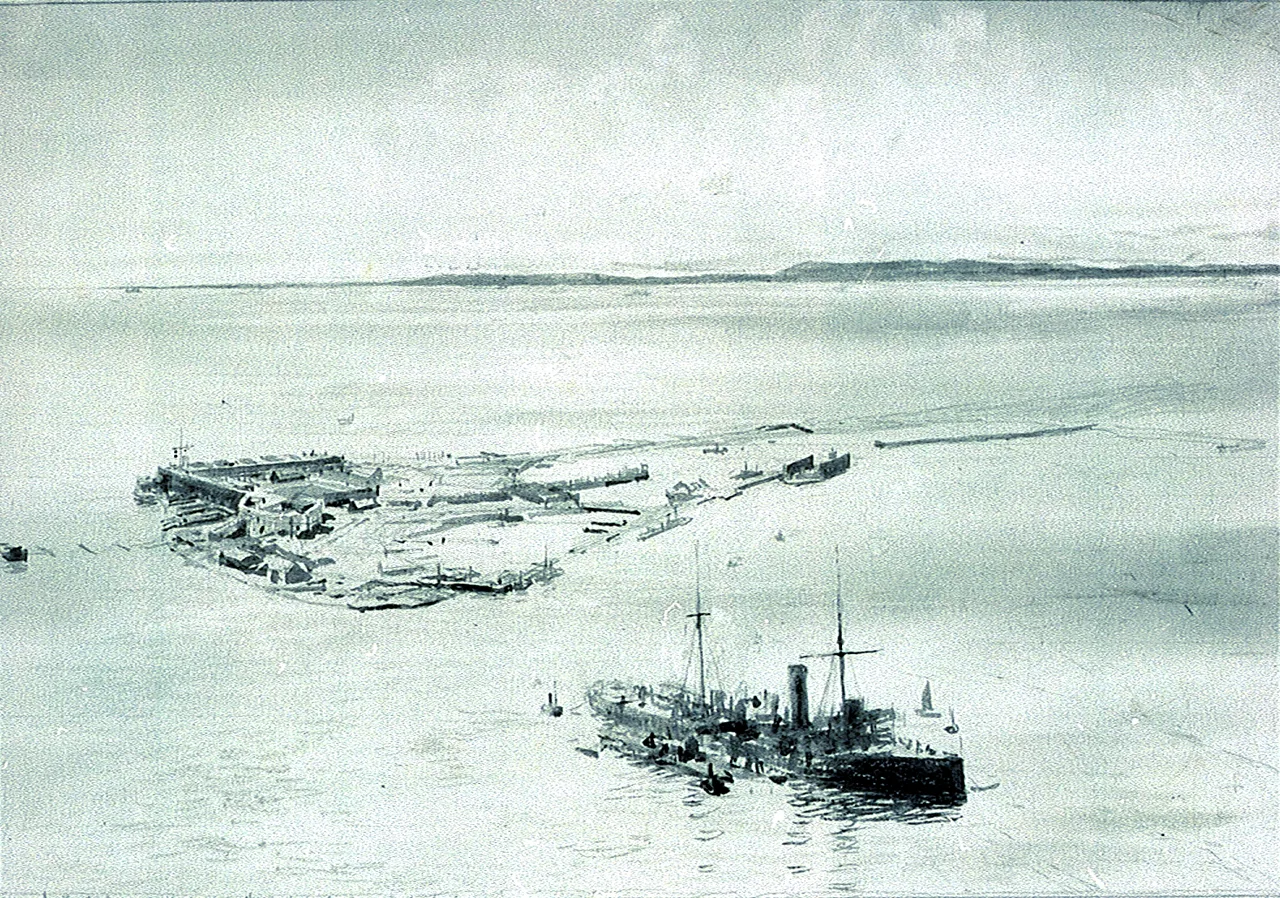 The submarine depot ship Forth and Fort Blockhouse, with the Isle of Wight beyond: a study by William Lionel Wyllie, about 1914.
Image: Royal Museums Greenwich, public domain, via Wikimedia Commons.

The Royal Navy's first submarine, Holland 1, was launched on 2nd October 1901, and the first submarine flotilla formed at Portsmouth in 1902 around the depot ship HMS Hazard. The Boats needed a permanent home.
In 1904, with defensive minefields falling out of use, the First Sea Lord, Admiral Sir John Fisher, began arranging for the submariners to move into Fort Blockhouse. Dredging for a submarine dock at Haslar was under way by June 1904. The earliest naval log headed "Fort Blockhouse" begins on 16th May 1905, and the Army's mining militia shared the site until 1907. Sources date the start of the submarine base to 1904 or 1905; both are right, depending on whether preparation or occupation is counted.
In 1907 an old hulk named HMS Dolphin was brought alongside to give the submariners somewhere to sleep. About May 1912 the Portsmouth Boats became the Second Submarine Flotilla, with Dolphin as their depot. On 31st August 1912 the base became an independent command under Captain Roger Keyes, Commodore in charge of the Submarine Service, and it took the hulk's name. HMS Dolphin it stayed for the next 86 years.
Hazard Block, built in 1913 for senior officers, is one of the few buildings left from the original submarine base.
The First World War
From 1914 the Portsmouth Boats, with Dolphin as their depot, formed part of the Portsmouth Defence Flotilla. Submarines were kept on station off St Helens Fort against a feared raid on Portsmouth by the German High Seas Fleet.
In August 1917 Commodore Sydney Hall asked the Admiralty for a school for submarine commanding officers that would concentrate entirely on attacking through the periscope. The Periscope School opened at Dolphin the next month. Its first instructor was Lieutenant Commander Henry Gill, and its first graduate, Lieutenant John Mundell, passed on 6th October 1917. It was the forerunner of the Commanding Officers' Qualifying Course, known to every submariner as "Perisher". Seventy-five officers passed through before the school moved to Campbeltown in October 1918.
The Submarine Memorial Chapel of St Nicholas was built on top of the North Bastion in 1917, to commemorate Royal Navy and Allied submariners lost at sea. The war cost the Submarine Service 54 Boats, 138 officers and 1,225 men, about a third of its people.
Between the Wars
After the war a memorial dining hall was added to Thames Block, hung with paintings of sailing ships by William Lionel Wyllie in memory of the submariners who died. Buildings on the site are named after the ships in the paintings.
The commanding officers' course came back to Fort Blockhouse in 1926. Accommodation did not keep pace. In March 1927 the First Lord of the Admiralty, Mr William Bridgeman, told the House of Commons that better accommodation at the Fort Blockhouse submarine base had been "an urgent requirement for a very long time". In July 1931 a Member of Parliament, Captain W. G. Hall, said men there were sleeping on floors and tables. A run of new blocks followed through the late 1920s and 1930s.
By 1932 the Boats at Dolphin formed the 5th Submarine Flotilla. In the 1930s escape training took place in a 15-foot tank at Dolphin, using the Davis Submerged Escape Apparatus, though not every submariner went through it. Between 1935 and 1937 a headquarters for the Rear Admiral, Submarines, was built overlooking the main jetty and Haslar Lake.
The Second World War
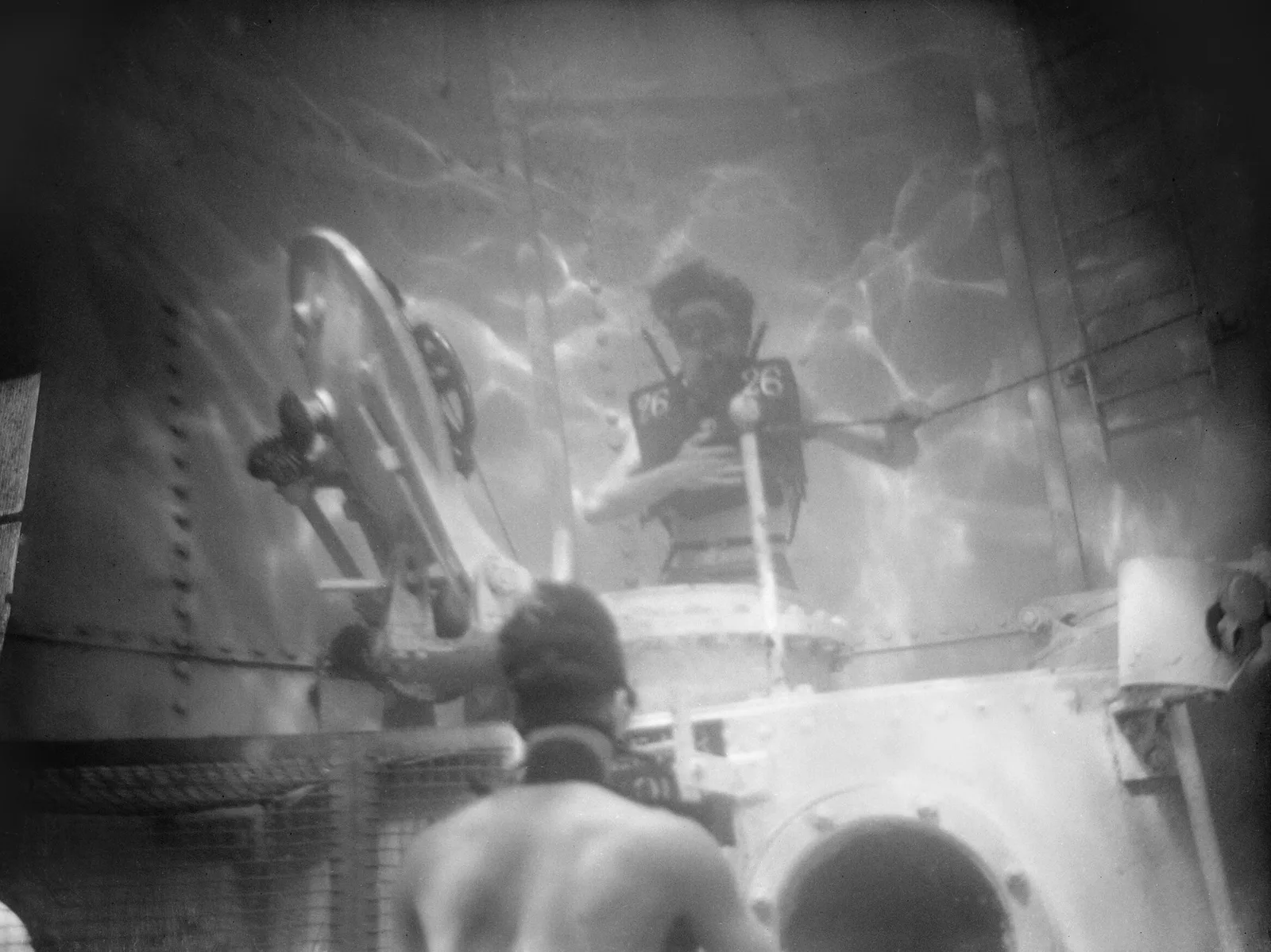 Testing Davis escape apparatus in the escape training tank at HMS Dolphin, 14th December 1942.
Photo: Lieutenant C J Ware, Royal Navy official photographer (IWM A 13873), public domain, via Wikimedia Commons.

When war came in September 1939 Dolphin was home to the 5th Submarine Flotilla, operating in the Channel and the Bay of Biscay. At the end of August 1939 the Admiral's headquarters moved away, and most submarine training went elsewhere. From April 1941 new submariners trained at Blyth, where it was safer.
Dolphin stayed in the fight. In September 1940 Vice Admiral Max Horton, Flag Officer Submarines, moved as many submarines as possible to Fort Blockhouse. On 7th November 1940 HMS Swordfish sailed from the Petrol Quay at Fort Blockhouse for a patrol off Brest and was lost with all hands.
Escape training carried on. From April 1941 to June 1944 Lieutenant Commander William Shelford ran Davis apparatus training at Dolphin, and official photographs taken on 14th December 1942 show men practising in the escape tank. The attack teacher kept working too, crewed from 1941 by Wrens.
Dolphin was also home to some of the war's most secret work. The beach reconnaissance parties that became the Combined Operations Pilotage Parties gathered and trained here. In January 1944 the midget submarine X20, commanded by Lieutenant Ken Hudspeth, sailed from Dolphin to survey the Normandy beaches, and in June 1944 X-craft from HMS Dolphin marked the D-Day landing beaches.
Of the 206 submarines the Royal Navy sent to sea in the war, 74 were lost, and 3,508 of its 9,310 submariners were killed or captured.
The Cold War Years
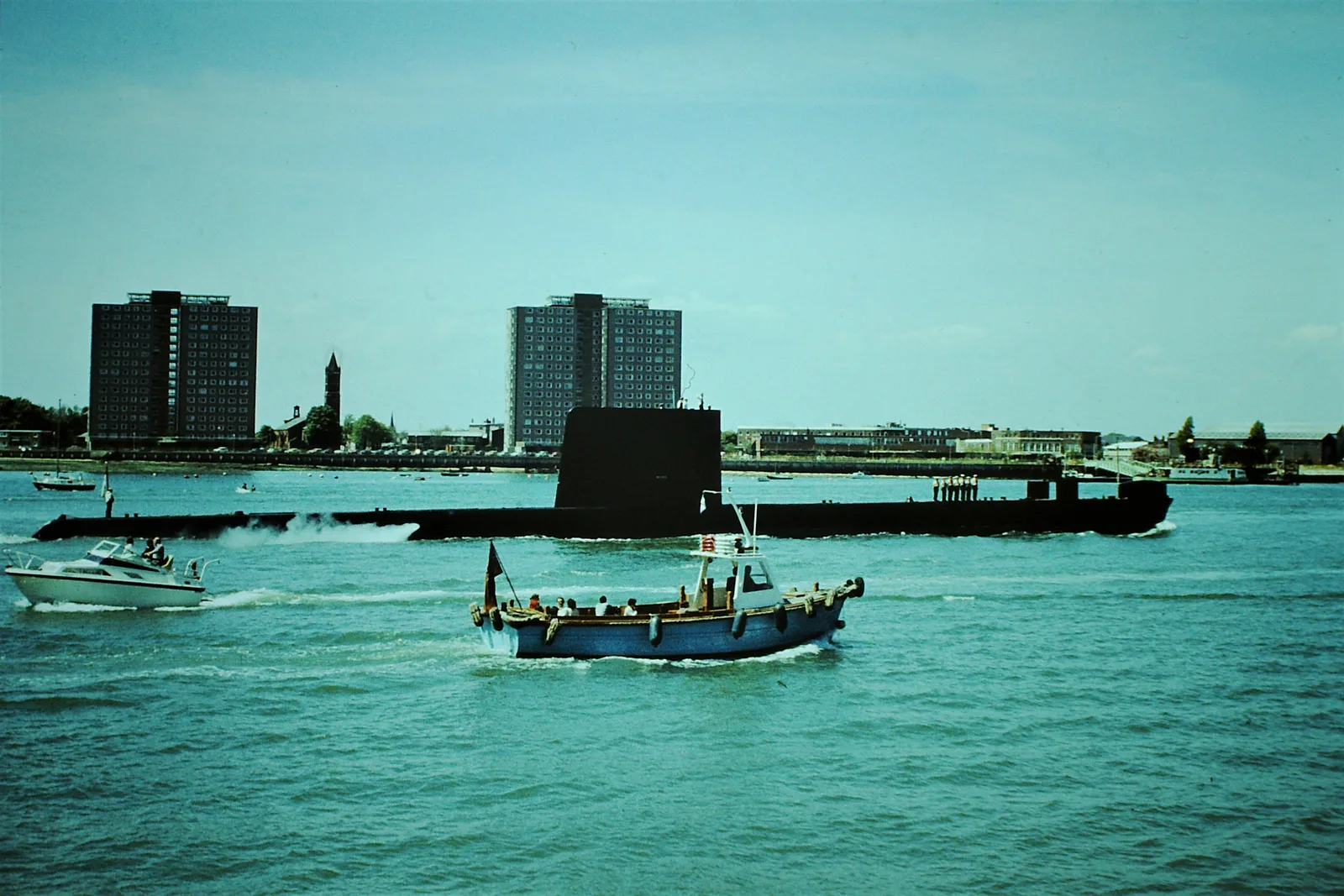 HMS Opossum entering Portsmouth Harbour for Gosport, May 1979.
Photo: Hugh Llewelyn, CC BY-SA 2.0, via Wikimedia Commons.

After 1945 Dolphin went back to being the main base of the Submarine Service. Its Boats were prepared, maintained and crewed from Gosport, and the post-war 5th Submarine Flotilla, later the 5th Submarine Squadron, was based there. In 1961 the squadron became the 1st Submarine Squadron, known as SM1, under its first Captain, Captain L. W. Napier.
On 8th June 1959 Her Majesty The Queen presented the Queen's Colour to the Submarine Service at HMS Dolphin. On 7th July 1961, its Diamond Jubilee year, the Submarine Branch was granted the Honorary Freedom of the Borough of Gosport.
In the mid-1960s, as the Submarine Service took on the nuclear deterrent, new training buildings went up outside the old fort, land was reclaimed along Haslar Creek and the jetty was widened. A collection of submarine relics started in Dolphin in 1962 grew into the Royal Navy Submarine Museum.
On 1st July 1971 HMS Artemis sank alongside the jetty at Dolphin. Three Sea Cadets aboard were got out, but three men were trapped in her forward torpedo compartment for about ten hours before escaping through the forward escape hatch early the next morning. Ordnance Electrical Artificer First Class David Guest was awarded the George Medal, and Acting Leading Marine Engineering Mechanic Donald Beckett, Leading Marine Engineering Mechanic Robert Croxon and Marine Engineering Mechanic Ian Ralphs the British Empire Medal for Gallantry. Artemis was raised on 6th July.
HMS Alliance came home to Dolphin on 14th March 1973 to end her seagoing career as a harbour training Boat. She passed to the Submarine Museum in 1978, was lifted out of the water in June 1981 and opened to the public on 24th August 1981.
In 1978 Flag Officer Submarines moved his headquarters from Dolphin to Northwood, to work alongside the Fleet. Dolphin remained the base of the 1st Submarine Squadron and the parent establishment of the Submarine School.
As the Cold War ended, the diesel Boats went. HMS Opossum, the last Oberon class Boat in service, made her final run into Dolphin in 1993 under her paying-off pennant, ending some ninety years of submarine operations from Gosport. The 1st Submarine Squadron left Dolphin on 30th September 1993 and was formed again at Faslane the next day. That autumn Lady Fieldhouse, widow of Admiral of the Fleet Lord Fieldhouse, unveiled a plaque at Dolphin marking the squadron's departure. With her were Flag Officer Submarines, Vice Admiral Toby Frere, the last Captain SM1, Captain Paul Branscombe, and the squadron's first Captain, Captain Napier, now retired.
The Submarine Escape Training Tank
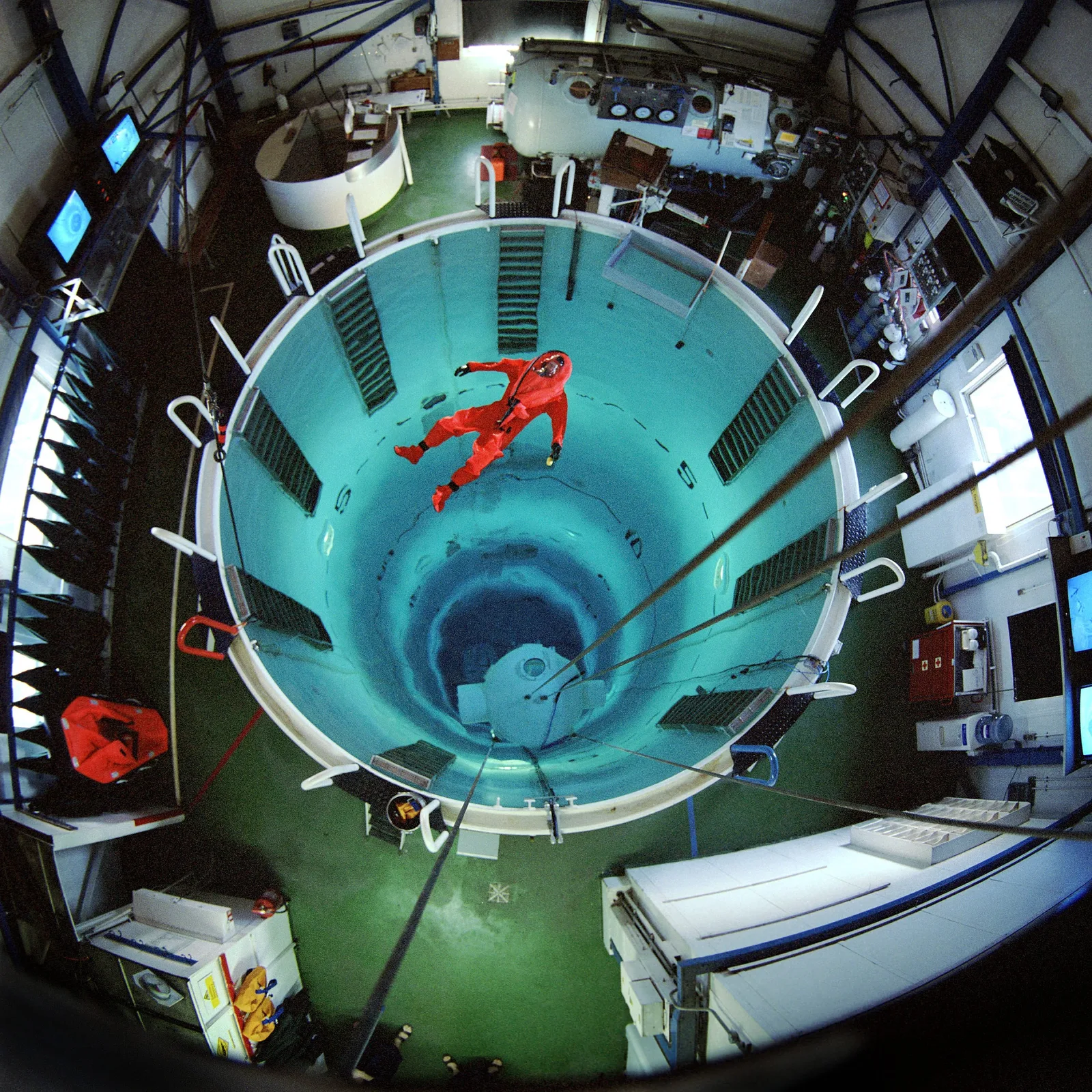 Looking down into the Submarine Escape Training Tank, 2004.
Photo: POA(Phot) Gary Davies / MOD, Open Government Licence v1.0, via Wikimedia Commons.

The losses of HMS Thetis in 1939 and HMS Truculent in 1950 led the Admiralty to decide that every submariner must be trained to escape. The Submarine Escape Training Tank (SETT) was built at Dolphin between 1949 and 1953: a column of water 100 feet (30 metres) deep inside a tower that became a Gosport landmark. From the first ascent on 13th July 1954 until escape training moved to Faslane in 2020, generations of submariners learned to escape there, and the tank staff set world records for escape from deep water. The tank was listed Grade II on 26th June 2013.
Read the full story of the Submarine Escape Training Tank
The Royal Navy Submarine School
Training was at Dolphin's heart from the start, from the Periscope School of 1917 to the Royal Navy Submarine School, which every officer and rating joining the Submarine Service passed through. New training buildings went up in the 1960s, and by 1980 some 5,000 people a year passed through its 230 courses. The school stayed at Dolphin until 23rd December 1999 and reopened at HMS Raleigh, Torpoint, in January 2000.
Read the full story of the Royal Navy Submarine School
Closure
With the Boats gone, Dolphin had ceased to be an operating base in 1993. In September 1996 the Ministry of Defence proposed closing it. On 29th October 1996 the Minister for the Armed Forces, Mr Nicholas Soames, told the House of Commons that the Submarine School would move to HMS Raleigh at Torpoint in Cornwall, and that the escape tower would stay at Dolphin, where "considerable sums have recently been spent on refurbishing and updating it". He added that "the move will certainly not be the end of HMS Dolphin, which will continue to play an important part in the life of the Royal Navy." The Royal Defence Medical College moved into the site in 1997.
The base's church, St Ambrose, a former Stokers' Mess, held its last service in December 1997. In September 1998 Flag Officer Submarines, Rear Admiral Rob Stevens, unveiled a memorial to all who served in HMS Dolphin, and HMS Spartan became the last submarine to salute her.
HMS Dolphin was decommissioned on 30th September 1998. At Sunset the White Ensign was lowered and handed to Commander Jeff Tall, Director of the Royal Navy Submarine Museum, and the keys of Fort Blockhouse passed from Admiral Nigel Essenhigh, Commander-in-Chief Fleet, to Air Marshal John Baird, the Surgeon General.
The Submarine School stayed until 23rd December 1999. At its final divisions the whole school formed up in the shape of a submarine. It reopened at HMS Raleigh in January 2000.
Fort Blockhouse Since 1999
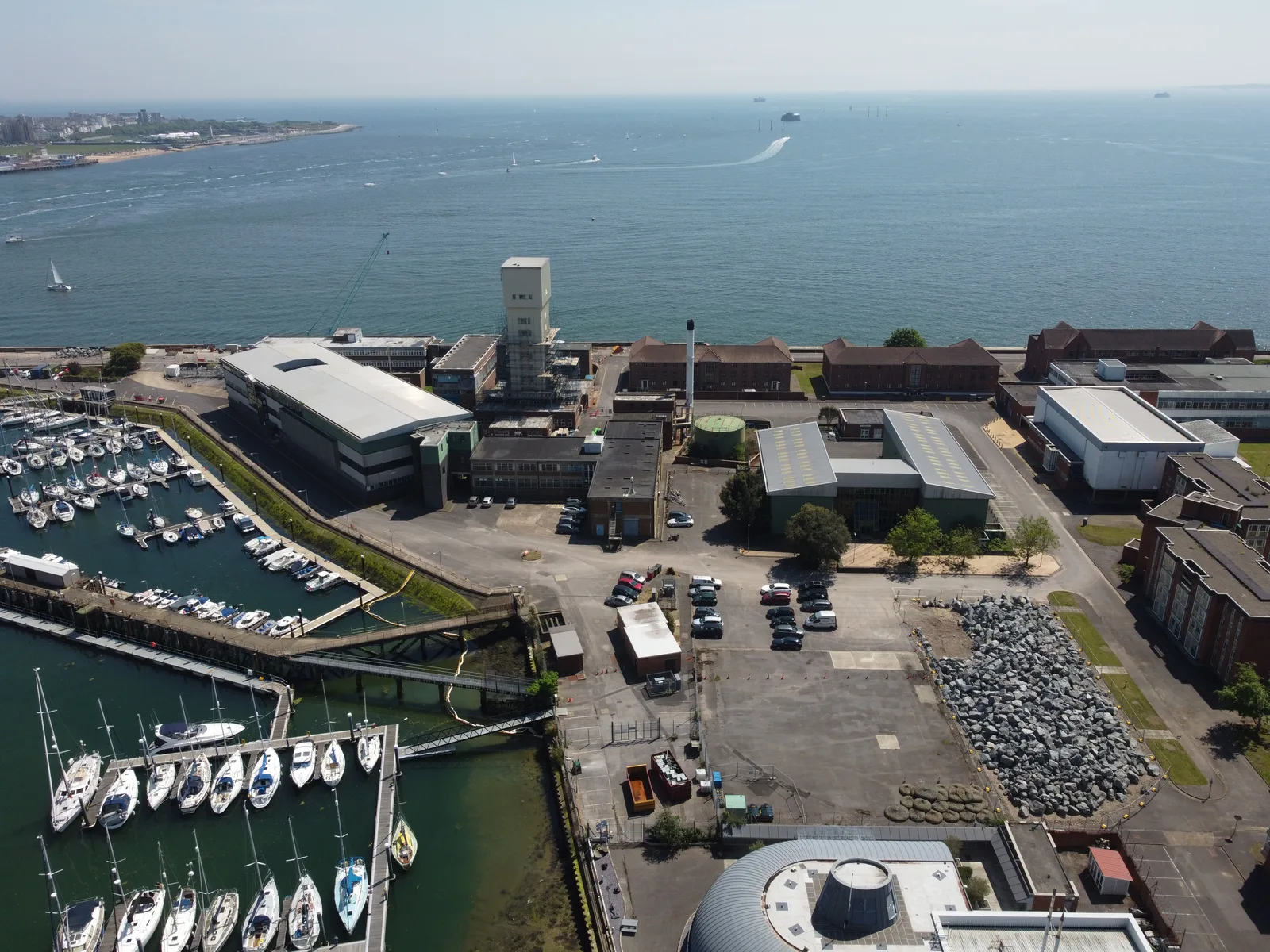 The former HMS Dolphin, with the escape training tower, from Haslar.
Photo: Tim Sheerman-Chase, CC BY 2.0, via Wikimedia Commons.

The Royal Defence Medical College left for Birmingham in 2002. The Army's 33 Field Hospital, based at Fort Blockhouse since 1996, took twin dolphins into its crest and stayed until it was disbanded on 1st December 2018.
On 7th November 2016 the Ministry of Defence's plan "A Better Defence Estate" listed Fort Blockhouse for disposal. On 17th November 2020 the Minister for Defence Procurement, Jeremy Quin, told Parliament the disposal would be delayed "to not before 2023" to meet military requirements. The site closed as a military establishment in December 2021.
The escape tank was studied in December 2023 for Gosport Borough Council and the Ministry of Defence. It was still full, holding 900,000 litres of water kept at 34 degrees. The tank and the frame of the tower were in reasonable condition, but the cladding and the buildings at its base were poor, a holding tank beneath it was "cracked and leaking badly", and repairs were put at about £11 million. The study found that draining, moving or demolishing the tank could not lawfully be allowed under national planning policy, and recommended treating it separately from the rest of the site.
In January 2026 the Defence Infrastructure Organisation told a House of Commons committee that a straightforward sale would not work and that it was looking at a partnership instead. In July 2026 the Ministry of Defence said it had commissioned specialist advice on the site's future.
Gosport's new Local Plan, submitted for examination on 5th November 2026, sets aside Fort Blockhouse for "heritage-led mixed-use regeneration", with about 475 homes and space for marine businesses. It requires the escape tank and the fort's heritage buildings to be kept and re-used.
On 4th October 2026 about 150 people from a small boat were brought ashore at Fort Blockhouse and taken on to Kent. The Home Office has since said it intends to find "a more suitable long-term contingency site".
The National Coastwatch Institution still keeps watch from the fort's signal tower. The rest of Fort Blockhouse stands empty, owned by the Ministry of Defence and waiting for a buyer, while the blocks where submariners once lived and trained deteriorate.
Managed Decline
For most of a century Dolphin trained the Submarine Service, housed it and sent its Boats to sea. What has happened to it since is set out here in the words of the official record.
When Fort Blockhouse was listed for disposal in 2016, it cost an estimated £4.29 million a year to run. After 33 Field Hospital was disbanded in December 2018, the fort was placed into what the Ministry of Defence's own conservation plan calls "a care and maintenance regime". By May 2024 that plan found the buildings "generally all in poor condition and beyond their design life".
Ministers have said as much. On 30th January 2023 the Defence Minister, Dr Andrew Murrison, told the House of Commons that Fort Blockhouse "is aesthetically charming, but it is beyond reasonable repair when it comes to accommodating servicemen and women". Storm Ciarán damaged the historic sea wall in November 2023, and in March 2024 the Ministry of Defence said its focus remained "the critical repair works" to the sea wall.
On 18th April 2024 the Member of Parliament for Gosport, Dame Caroline Dinenage, Chair of the House of Commons Culture, Media and Sport Committee, told the House: "When it comes to valuable heritage assets, I am really concerned about those housed in the grounds of our many military estates which are not bound by any of the obligations to maintain and care for them. In many cases, the Ministry of Defence and others are pursuing a policy of managed decline, which is allowing those valuable heritage assets to rot under our very noses. May I encourage the Minister—in fact, the Secretary of State—to speak with Ministers in the Ministry of Defence to challenge that policy and see what can be done to address it? I give her advance warning that I am keen to look at that as part of a Select Committee inquiry."
Her committee took it up in an inquiry, "Protecting built heritage". On 6th January 2026 she opened its questions to the Defence Infrastructure Organisation by saying that Historic England had identified the Ministry of Defence as one of "the worst culprits when it comes to the accountability and the enforcement of protecting their heritage assets". Major General Andy Sturrock, Director of Strategy and Plans, replied: "I don't think we recognise the term of managed decline as a positive policy action."
She then turned to Fort Blockhouse. It was, she said, "still sitting there and we are waiting for an outcome for this site, which is doing nothing for the constituency, nothing for the MOD, nothing for the public purse." Major General Sturrock told the committee that 29 firms had shown interest when the site was sounded out, that only two came to a meeting, and that "a straightforward sale will not work. It is not attractive enough." Dame Caroline answered: "That has been earmarked for disposal for 10 years now. That is a lot of cost that could have been saved if that had been recognised 10 years ago".
Fort Blockhouse is a scheduled monument with nine listed buildings and structures. Historic England keeps a Heritage at Risk Register of the most threatened historic places in England. Next door, on land the Ministry of Defence is keeping, the Grade II* former guard house and the boundary walls of the Haslar Gunboat Yard are on it. As of November 2026, no part of Fort Blockhouse is.
Planning Documents
Gosport Borough Council publishes the planning papers for Fort Blockhouse as part of the public examination of its new Local Plan. These are the main ones. Each opens as a PDF file unless it is marked as a web page.
The Local Plan
- Submission Gosport Borough Local Plan 2042: Gosport Borough Council, October 2026. Policy RA3 covers Blockhouse. PDF, 38 MB.
- Schedule of Suggested Main Modifications: Gosport Borough Council, September 2026. PDF, 17 MB.
- Local Plan examination: Gosport Borough Council. Web page.
- All the site evidence for Blockhouse: Part F1 of the examination library, more than 30 documents. Web page.
Heritage
- Fort Blockhouse Conservation and Archaeological Management Plan, Volume 1: WSP for the Defence Infrastructure Organisation, May 2024. PDF, 5 MB.
- Conservation and Archaeological Management Plan, Volume 2: Gazetteer: WSP for the Defence Infrastructure Organisation, November 2023. PDF, 13 MB.
- Conservation and Archaeological Management Plan: Figures: WSP for the Defence Infrastructure Organisation, May 2024. PDF, 26 MB.
- Submarine Escape Training Tank Feasibility Study: Colliers for Gosport Borough Council and the Defence Infrastructure Organisation, December 2023. PDF, 10 MB.
- Fort Blockhouse Summary Note: Heritage: WSP for the Defence Infrastructure Organisation, January 2026. PDF, 133 KB.
- Haslar Peninsula Conservation Area Appraisal: Gosport Borough Council, March 2007. PDF, 3 MB.
- Haslar Peninsula Heritage Assets Plan: Gosport Borough Council, February 2024. PDF, 3 MB.
- Heritage Investment Prospectus: Historic England, 2026. PDF, 11 MB.
The Ministry of Defence's Plans for the Site
- A Better Defence Estate: Ministry of Defence, November 2016. Web page.
- Fort Blockhouse Masterplan and Design Evolution: PRP for the Defence Infrastructure Organisation, January 2026. PDF, 8 MB.
- Fort Blockhouse Context Appreciation: PRP for the Defence Infrastructure Organisation, January 2026. PDF, 6 MB.
- Council officers' considerations on the Blockhouse masterplan: Gosport Borough Council, February 2026. PDF, 164 KB.
- Defence Infrastructure Organisation's comments on the Local Plan: JLL for the Defence Infrastructure Organisation, April 2026. PDF, 785 KB.
- Defence Infrastructure Organisation's comments on the draft Local Plan 2038: JLL for the Defence Infrastructure Organisation, 2021. PDF, 920 KB.
- Fort Blockhouse sea wall letter: Defence Infrastructure Organisation to Gosport Borough Council, February 2026. PDF, 115 KB.
- Fort Blockhouse 1 Flood Risk Assessment: WSP for the Defence Infrastructure Organisation, November 2026. PDF, 10 MB.
- Blockhouse Site Layout and Building Schedule: Defence Infrastructure Organisation, July 2005. PDF, 1 MB.
The Listed Buildings
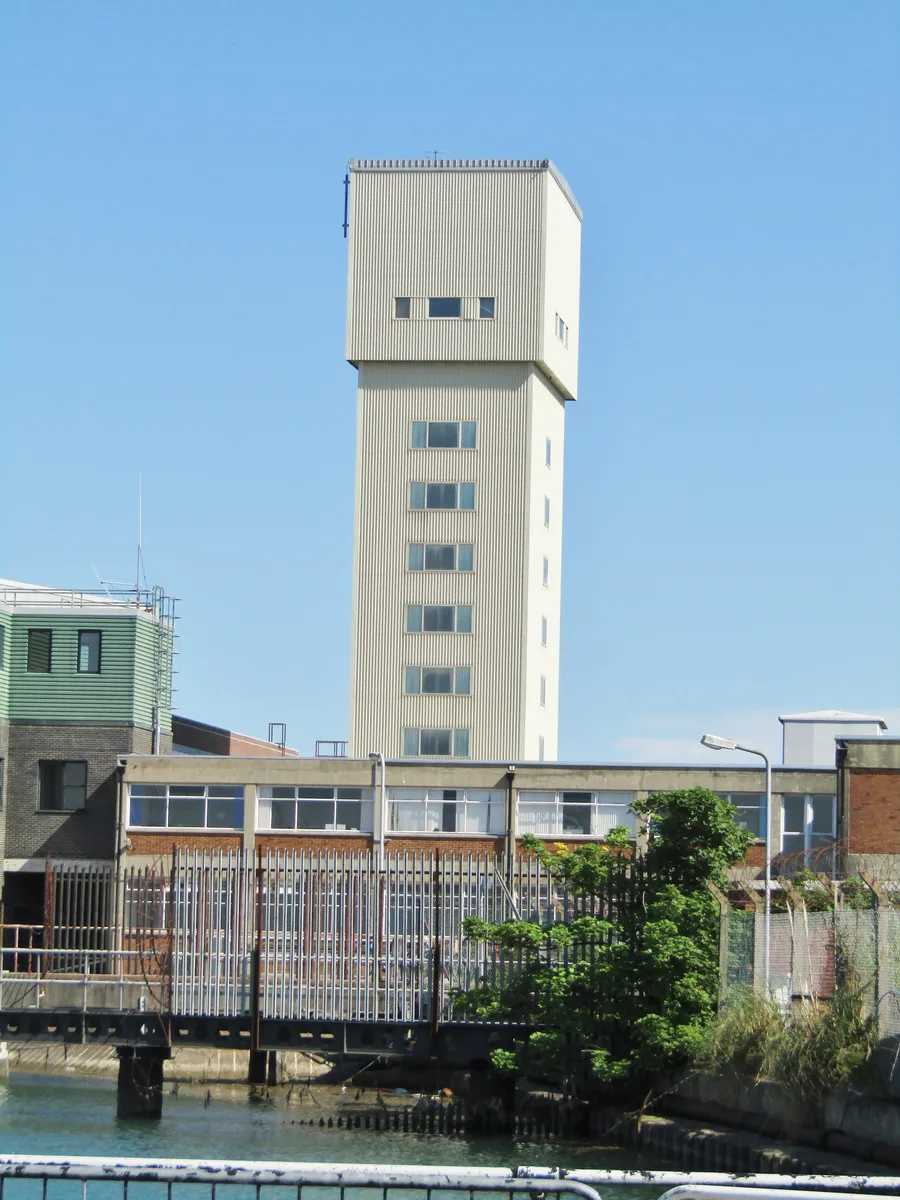 The tower of the Submarine Escape Training Tank, listed Grade II, 2018.
Photo: Colin Smith, CC BY-SA 2.0, via Geograph.

Fort Blockhouse has been a scheduled monument since 16th March 1964. The Submarine Escape Training Tank was listed Grade II in 2013, and on 13th November 2020 Historic England listed eight more structures at Grade II:
- the Submarine Memorial Chapel of St Nicholas (1917), on the North Bastion
- the Submariners' Memorial
- Thames Block (1845 - 1847), the officers' quarters, with its memorial dining hall
- Arrogant Block (1845 - 1847), the men's quarters
- the former guardhouse, now known as the Post Office
- the gatehouse datestone of 1709
- the Admiralty boundary stone of 1774
- a cannon used as a bollard
Visiting Today
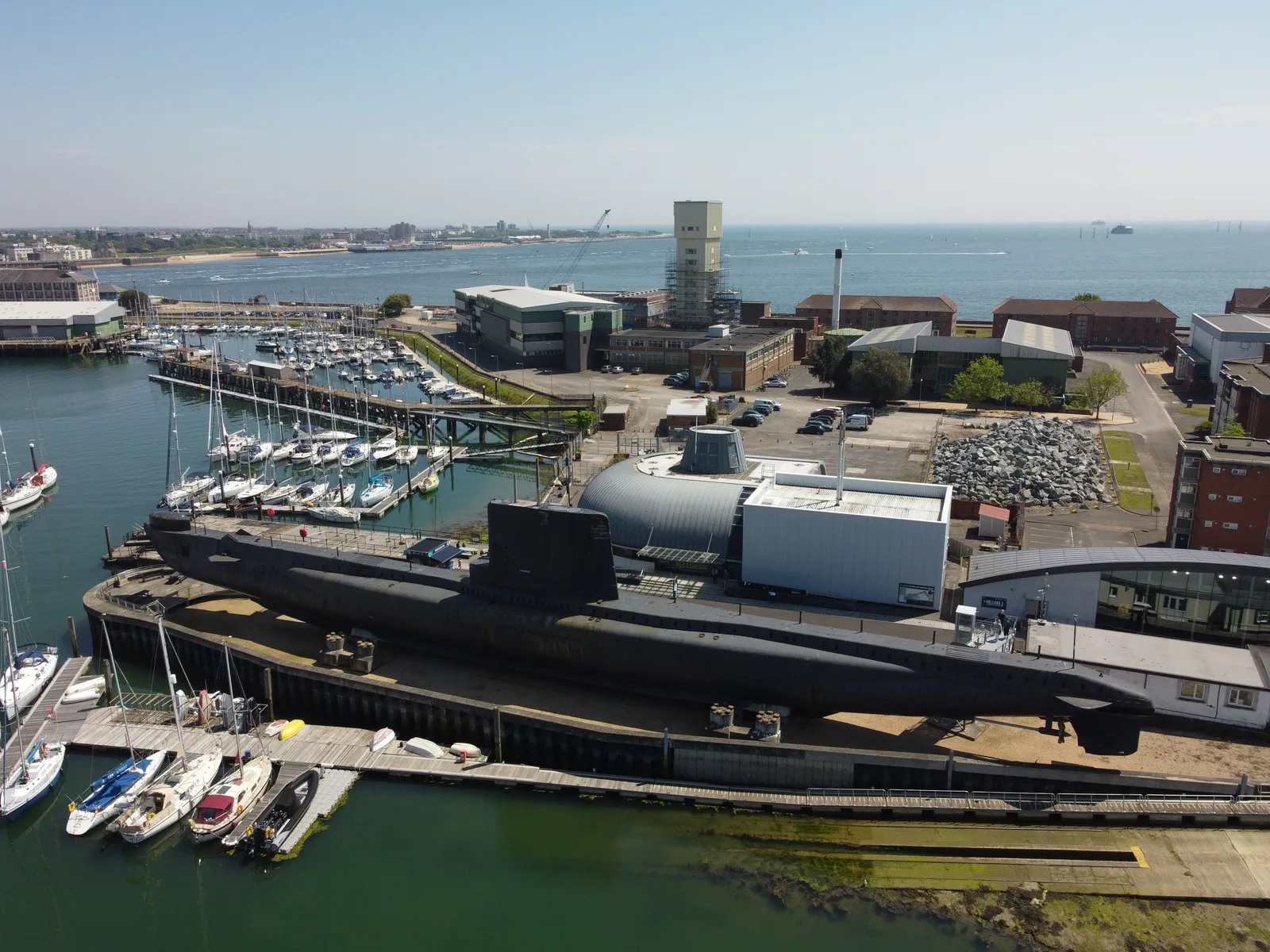 HMS Alliance at the Royal Navy Submarine Museum, with the escape training tower behind, 2024.
Photo: Tim Sheerman-Chase, CC BY 2.0, via Wikimedia Commons.

Fort Blockhouse itself is closed to the public. Next door, on land the Ministry of Defence is keeping, the Royal Navy Submarine Museum on Haslar Road, Gosport, tells the story of the Service. Visitors can go aboard HMS Alliance and see Holland 1, the Royal Navy's first submarine. The escape tank tower can be seen from the museum and from the water.