
Submarine Escape Training Tank
The 100-foot tower at HMS Dolphin, Gosport, where Royal Navy submariners learned to escape, 1954 - 2020.
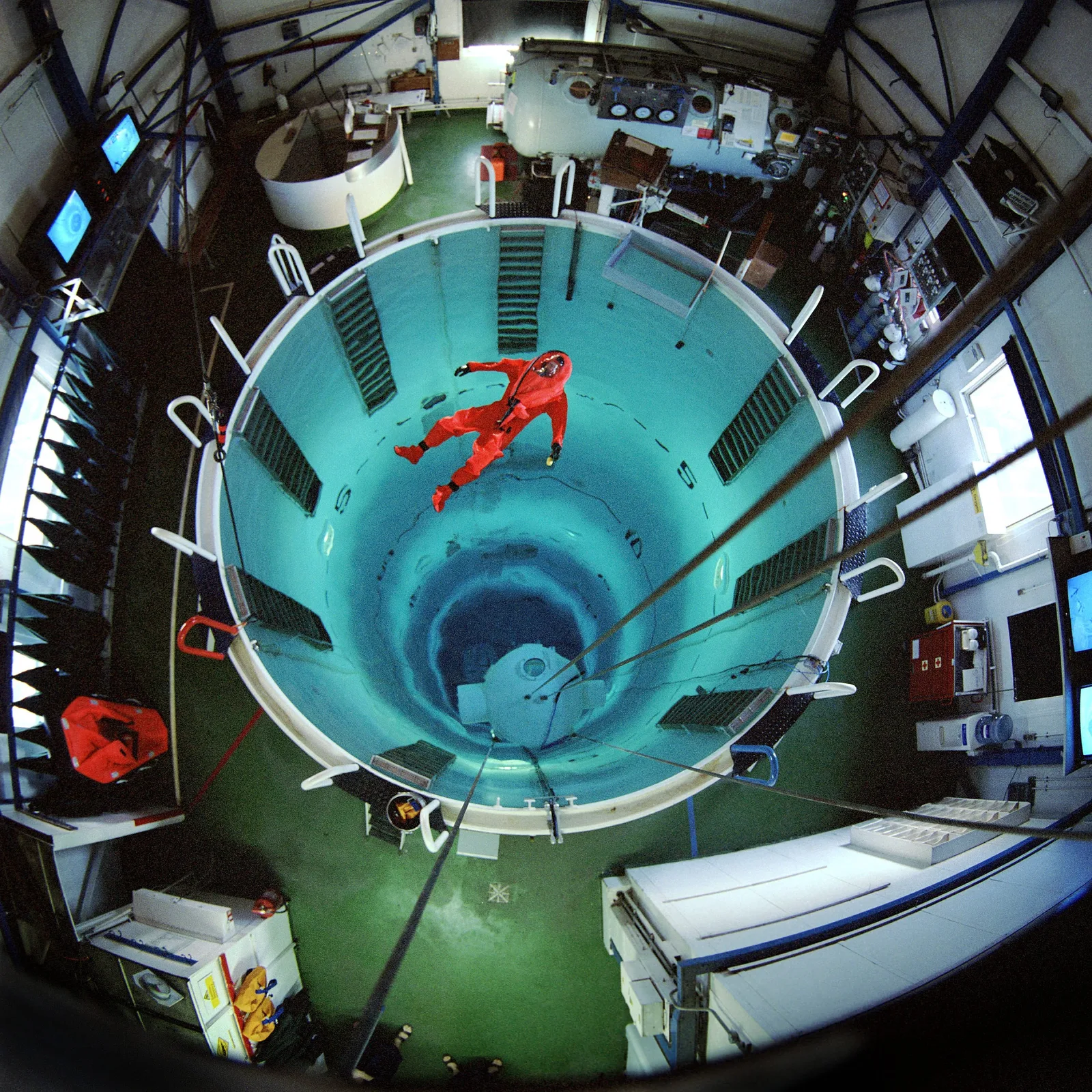 Looking down into the Submarine Escape Training Tank, 2004.
Photo: POA(Phot) Gary Davies / MOD, Open Government Licence v1.0, via Wikimedia Commons.

The Submarine Escape Training Tank (SETT) at Fort Blockhouse, Gosport, trained generations of Royal Navy submariners to escape from a sunken submarine. From the first ascent in 1954 until escape training moved to Faslane in 2020, men made the ascent from the bottom of its 100-foot column of water, and its tower became a Gosport landmark. It was listed Grade II in 2013.
Before the Tower
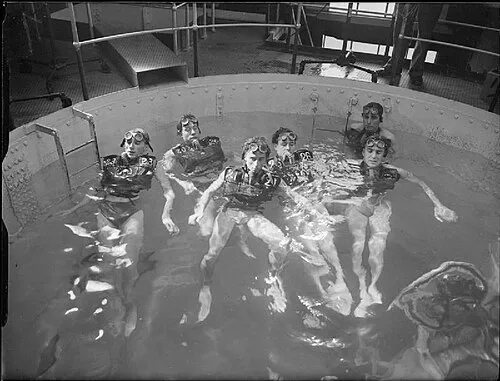 Escape training in the old tank at HMS Dolphin, 1942.
Photo: Lieutenant C. J. Ware, Royal Navy official photographer (IWM A 13876), public domain, via Wikimedia Commons.

Escape training at Dolphin began long before the tower. A tank 15 feet deep was built there in 1930, with others soon after at Malta and Hong Kong, and every officer and rating joining submarines took a two-day course in it, learning to use the Davis apparatus.
Why It Was Built
The losses of HMS Thetis in 1939 and HMS Truculent in 1950, both with heavy loss of life, shaped what came next. In 1946 a committee under Captain Phillip Ruck-Keene found that wartime disasters had been caused almost entirely by ignorance of simple physiology and of how to use the escape equipment. The Admiralty decided that every submariner must be trained to escape, and that a free ascent, breathing out all the way up, gave the best chance from moderate depths. On 6th March 1952 it told the House of Commons it hoped to finish "a 100 foot escape tower" that summer, for training in free ascent from the one-man escape chamber being fitted in all new submarines.
Building the Tank
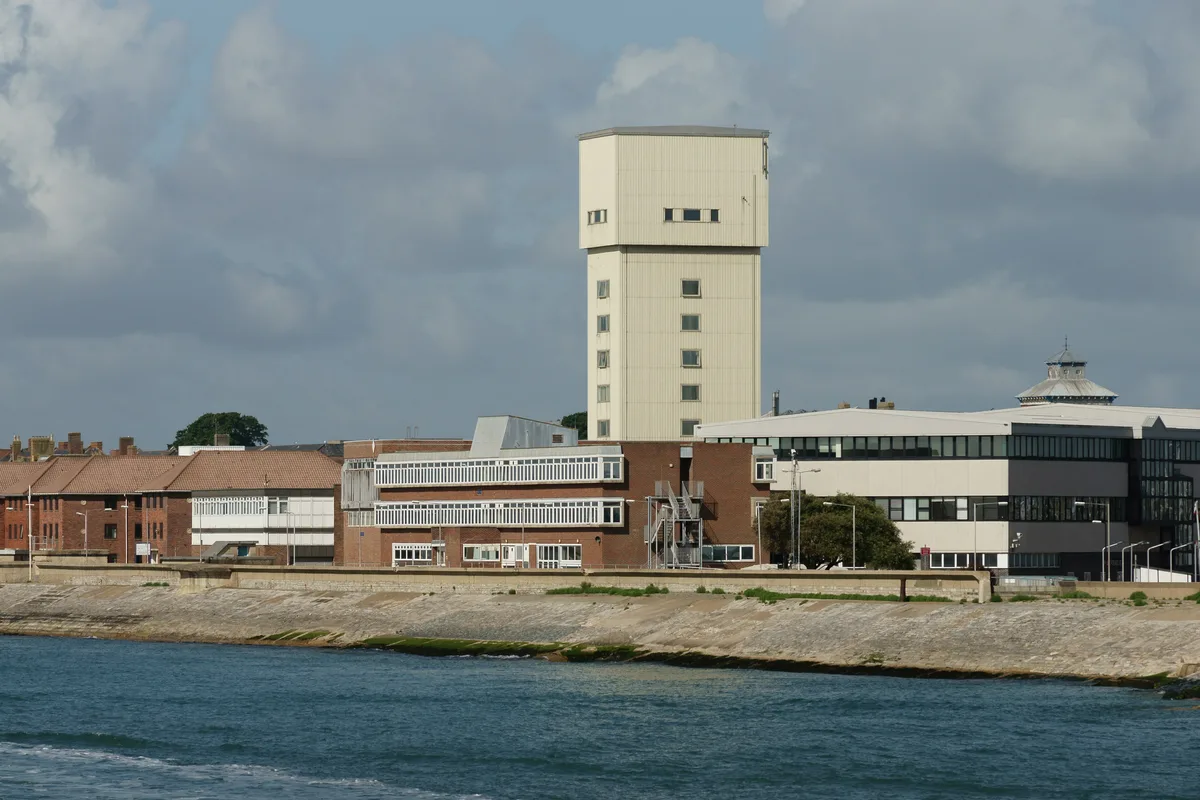 The Submarine Escape Training Tank from the harbour mouth, 2014.
Photo: Peter Trimming, CC BY-SA 2.0, via Wikimedia Commons.

The tank was designed by the Admiralty's Civil Engineer-in-Chief's Department and built in the early 1950s. A steel-framed tower went up first, and the tank was assembled inside it from drum-shaped steel sections, standing free on a piled concrete base and held in place by its own weight and the weight of the water. It holds about 900,000 litres of water, kept at 34 degrees Celsius so that the instructors could work all day in swimming trunks.
The tower has ten floors. Air locks open into the tank at 9 metres (floor 7) and 18 metres (floor 4), with offices, a students' rest room and the instructors' breathing stations between them. A decompression chamber stands at the top, and the depth is painted on the side of the tank every five metres. A diving bell ran the full height for the instructors; it is now in store next door.
The first man made the ascent on 13th July 1954. By February 1955 the thousandth trainee had passed, at about fifty men a week. In the 1960s and 1970s around 4,500 submariners a year made the ascent, and the tank is thought to have been used more than 150,000 times.
How Men Trained
Training changed over the years, but the principle did not: a man learned to rise from depth breathing out steadily, so the expanding air in his lungs could not harm him. In the early 1970s a trainee in swimming trunks, life-jacket, goggles and nose-clip made buoyant ascents from 30 and 60 feet, then an escape from 100 feet in a hooded suit. Instructors waited in the water at every stage, watching each man for the stream of bubbles that showed he was breathing out. In 1997 nine instructors were in the water for every ascent.
By March 1968 a full-size copy of the Single Escape Tower, already fitted in operational submarines, had been built onto a mock submarine hull at the bottom of the tank, so men trained with the same gear they would use at sea; more than 5,000 submarine and dockyard personnel had already been through it. The tower was designed by Lieutenant Commander Laurence Hamlyn, a former Submarine Command Escape Officer, and Mr Kenneth Tayler of the Director-General Ships' department, who each received an award of £1,500 for it in 1968.
The suits developed with it. The Mark 7 came in 1972 and the Mark 8 in 1987, and in 1995 the Mark 10 escape equipment, with its own one-man life raft, became standard.
From 1972 a submariner's pay depended on keeping his escape training in date. That link was dropped in 1975 and restored from 1st January 1986, with requalification after three years and then every four and a half years.
The Tank Crew and Their Records
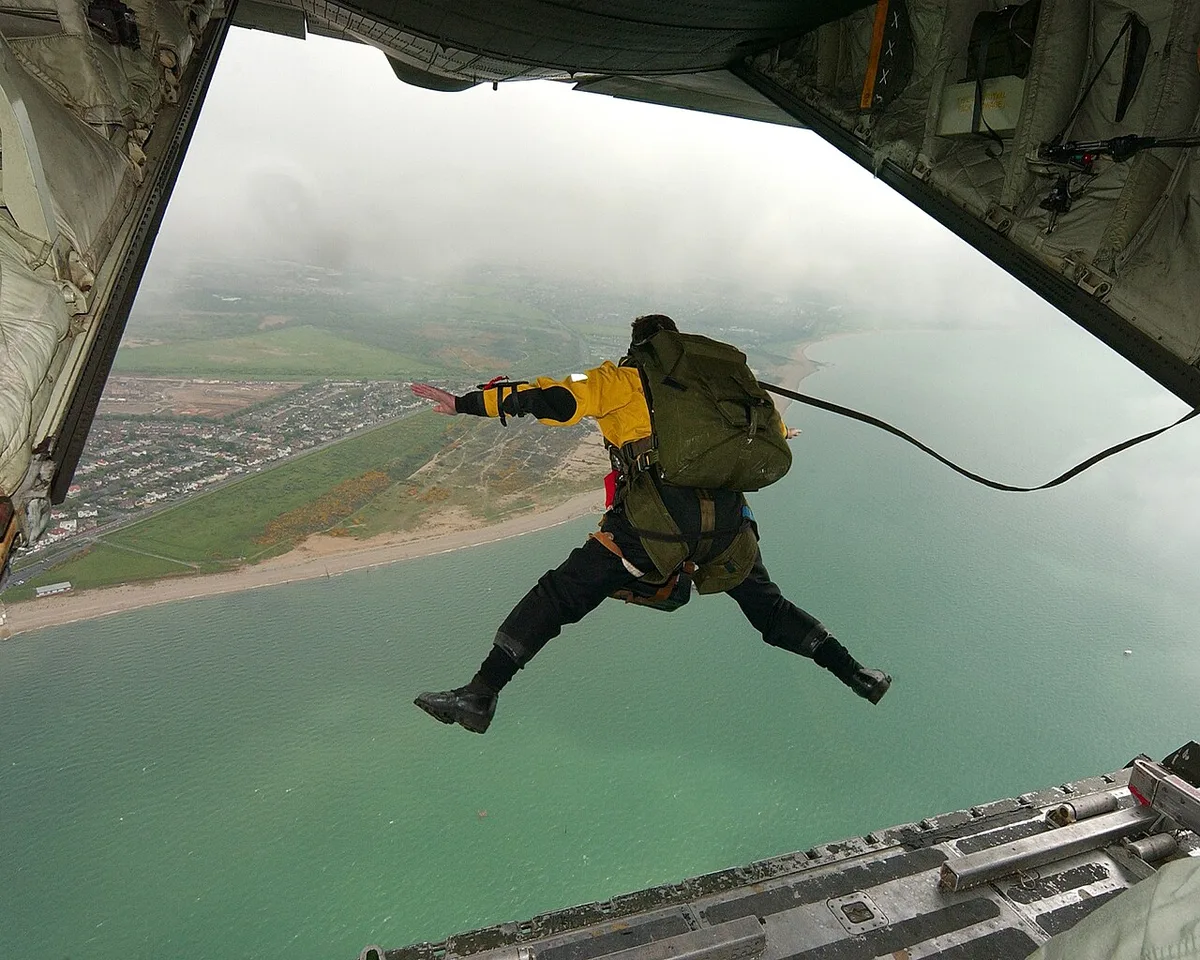 Tank staff of the Submarine Parachute Assistance Group jump from a Hercules off Lee-on-the-Solent, 2006.
Photo: LA(Phot) Owen King / MOD, Open Government Licence v1.0, via Wikimedia Commons.

The tank's instructors were volunteers, all qualified submariners, and it took about four months to train one. They did more than teach. They tested the hood and immersion suit that let a submariner escape from deep water, and in July 1965 ten of the SETT crew made a record 500-foot escape from HMS Orpheus. In July 1970 a team of twelve led by Lieutenant Commander Matthew Todd made a training escape from HMS Osiris lying at 525 feet on the bottom of the Mediterranean off Malta. In July 1987 the tank staff took the Single Escape Tower to sea in HMS Otus and set a world record escape depth of 601 feet, wearing the Mark 8 suit.
The tank staff also formed the Submarine Parachute Assistance Group, ready to parachute into the sea beside a sunken submarine at a few hours' notice.
Visitors and Other Navies
Prince Charles made escape ascents from 30 and 60 feet in January 1972. The tank's visitors' book, which he and Prince Philip signed, went north to Faslane when training moved there, and Prince William signed it in 2021.
Submariners from many navies trained in the tank. German crews came from 1958, fifty in June 1960 and seventy in July 1967, and Historic England records that fifteen foreign and Commonwealth navies used it.
Safety and Losses
Escape training carried real risk. A medical team was always in attendance and a decompression chamber stood at the top of the tank, but men still lost their lives after training ascents.
On 9th September 1966 Lieutenant Commander Ralph Cudworth, the Deputy Command Escape Officer, collapsed after an ascent and died. On 21st September Marine Engineering Mechanic Michael Alsop, aged 19, died after his first training ascent from 30 feet. Training stopped until after the inquests, which returned verdicts of accidental death. Press reports at the time, which we have not been able to confirm from an official source, said that Cook Mervyn Hartrick, aged 21, died after a training escape in November 1970.
Able Seaman Geoffrey Lane, aged 18, was taken ill after his fourth ascent in the tank and died in the decompression chamber the following day, 1st March 1974. On 4th April 1974 Mr Frank Judd, the Under-Secretary of State for Defence for the Royal Navy, told the House of Commons that a board of inquiry had been held, that the training was being reviewed in the light of the coroner's views, and that escape training in the tank was suspended. On 9th December he told the House that training would start again in the new year, without the deepest 100-foot buoyant ascent and with an upper age limit of 35 for trainees.
In 1995 Able Seaman (Submariner) Adam Twells of HMS Sceptre, aged 24, died during an ascent in the tank.
The End of Escape Training at Gosport
When the Submarine School moved to HMS Raleigh, the tank stayed at Dolphin. On 29th October 1996 the Minister for the Armed Forces, Mr Nicholas Soames, told the House of Commons that "considerable sums have recently been spent on refurbishing and updating it". The tower had been re-clad in aluminium in 1994 - 1995.
Pressurised training for Royal Navy submariners stopped in the summer of 2008, and pressurised ascents ended altogether in 2012. The escape training team gathered at the tank for the last time on 9th January 2020, when the training moved to a new £34 million escape and survival facility at Faslane, opened by Prince William on 29th June 2021.
The Listed Tower Today
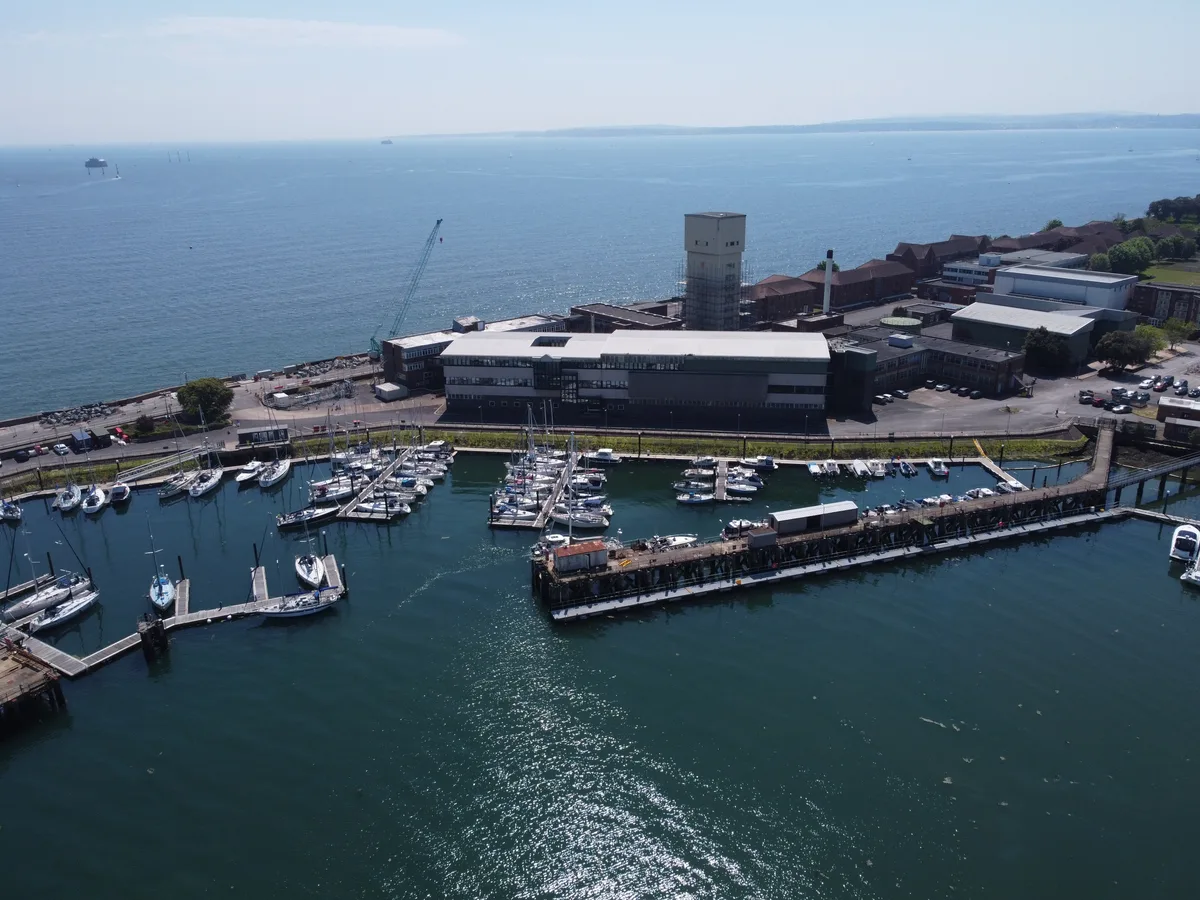 The tower partly in scaffolding, May 2024.
Photo: Tim Sheerman-Chase, CC BY 2.0, via Wikimedia Commons.

The tank was listed Grade II on 26th June 2013, for its rarity, its engineering, its influence on other navies and its place on the Gosport skyline. Fort Blockhouse itself has been a scheduled monument since 16th March 1964, and in 2020 Historic England listed eight more of its structures.
A survey in May 2023 found the tower frame in reasonable condition and the steel tank heavily rusted on the surface but deteriorating more slowly than in 2015. It is not safe for public access, chiefly for want of a protected escape stair, and a full refurbishment was costed at £11.2 million. By May 2024 part of the tower was in scaffolding. The site is closed to the public, but the tower can be seen from Haslar and from the Royal Navy Submarine Museum next door.