
Royal Navy Submarine School
Where Royal Navy submariners learned their trade, at HMS Dolphin, Gosport, and later at HMS Raleigh and on the Clyde.
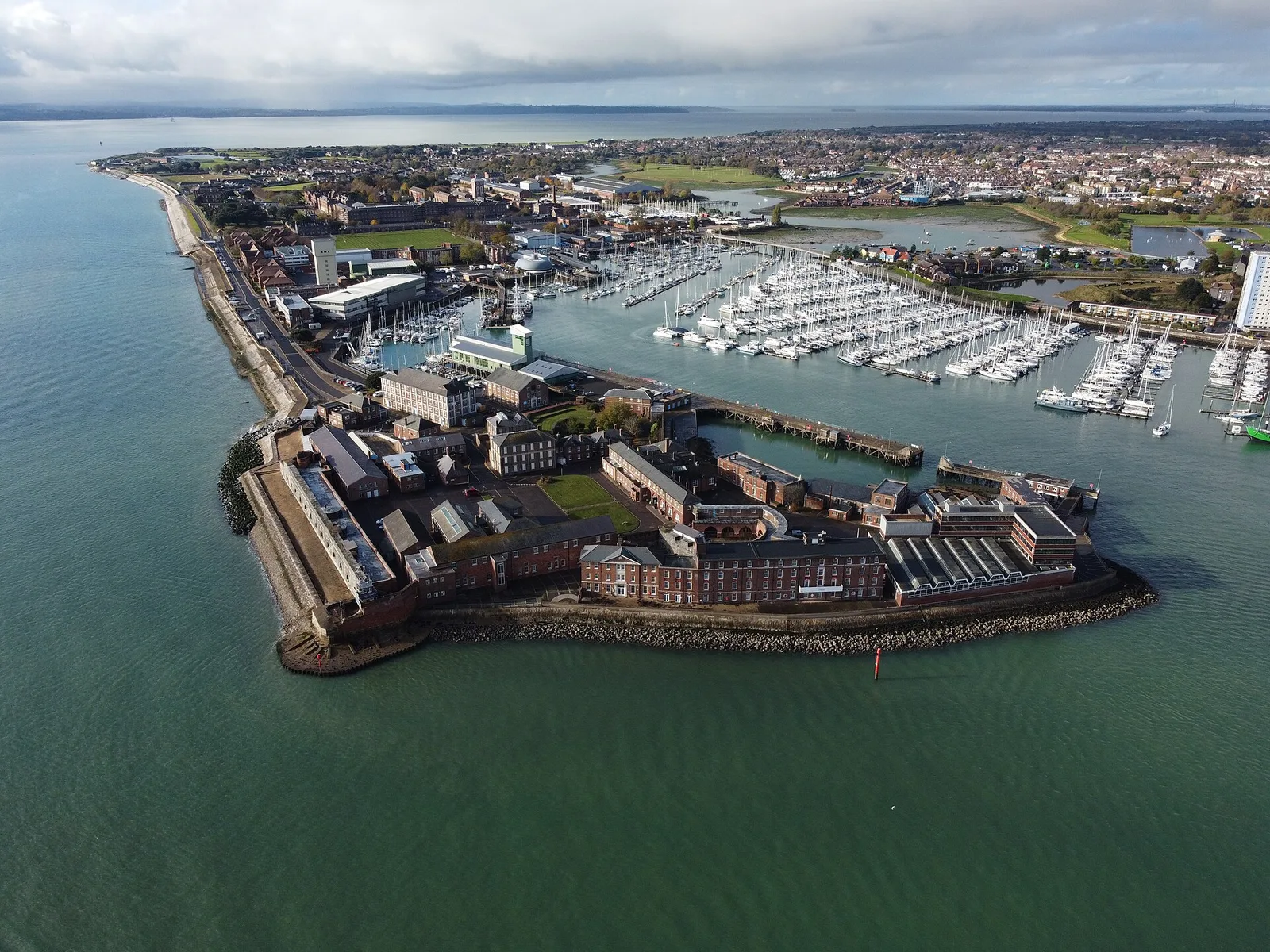 Fort Blockhouse, the former HMS Dolphin, from the air, 2021.
Photo: TimSC, CC BY-SA 4.0, via Wikimedia Commons.

Every officer and rating joining the Royal Navy Submarine Service passed through the Submarine School at HMS Dolphin, Fort Blockhouse, Gosport. It grew from the Periscope School of 1917 into a campus that trained some 5,000 people a year, and it stayed at Dolphin until 23rd December 1999, when it moved to HMS Raleigh at Torpoint in Cornwall. Today submarine training is moving to a new centre on the Clyde.
Early Years
Training was at Dolphin's heart from the start. The Periscope School for commanding officers began in HMS Thames at Sheerness, moved to Campbeltown at the end of the First World War, to Portland in 1919 and then to HMS Ladas at Portsmouth, and the commanding officers' course returned to Fort Blockhouse in 1926. The first attack teacher at the fort was a simple arrangement of wires and string set up in the Rose Garden. In 1939 it moved to a two-storey building beside the site of the later escape tank, with a dummy control room below and an assessing room above, and in the war it was manned by Wrens. During the Second World War training moved to Blyth for safety, and after the war it came back to Gosport.
Who Ran the School
The Captain of Dolphin also commanded the Submarine School, and from July 1960 his title was Captain, 1st Submarine Squadron and HMS Dolphin Submarine Base and School. A Commander ran the school from day to day, among them Commander Alistair Bruce (1980), Commander Bill Organ (1990), Commander David Vaughan (from 1993) and Commander Geoff Thomas, who led it out of Dolphin in 1999.
A New Training Area
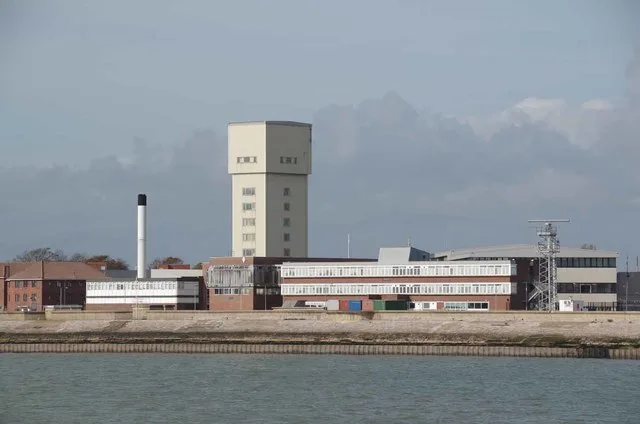 The escape tower and the former school blocks from the water, 2017.
Photo: Glyn Baker, CC BY-SA 2.0, via Wikimedia Commons.

For years after the war the school worked from a cluster of old huts known as the "Brown Area", with equipment taken from submarines on their way to the breakers. Most of the real learning was done at sea. The new classes of the 1960s, and above all the nuclear submarines, needed something better. The General Courses Building was opened in November 1965 by Rear Admiral T. H. Maxwell, the Director-General of Naval Training and himself a submariner. The Application Courses Building followed in September 1966, fitted with the latest fire control, communications and navigation equipment, and a Weapon Launch Building was added in 1967. By 1980 the school had its own campus of four blocks, named Mackenzie, Horton, Fisher and Keyes.
Qualifying and the Dolphins
Qualifying came in three parts: the theory, then how it applied to the man's own trade, and finally practical work in a submarine at sea. Depending on his specialisation it took between four and fifteen months. The first two parts were taught at the school. The third, known as Part III, was done in a Boat, and only when it was signed off did a submariner earn his badge.
That badge has its own history. In 1958 the Admiralty approved the first submarine badge for ratings, a sleeve badge showing the silhouette of a submarine, worn on the left cuff by men who had passed an examination four to six months after joining their first submarine. The gold Dolphins came later. Authorised by The Queen for qualified submariners, officers and ratings alike, the badge shows two dolphins supporting a crown over a fouled anchor. The first were presented at HMS Dolphin, the Clyde Submarine Division and Vickers' yard at Barrow-in-Furness on 15th July 1971, with smaller ceremonies at Rosyth, Devonport, Chatham, Birkenhead and Dounreay.
A Growing School
In 1980 some 5,000 people a year, from Captains to Ordinary Seamen, passed through one or more of the school's 230 courses, which ran from a single day to six months, and it took in 1,200 new submariners a year. In 1989 it gave initial submarine training to 100 officers, 200 senior ratings and 600 junior ratings, and ran courses for students from 11 overseas navies.
In 1959 three classes of commanding officers a year, five British officers and usually one from another NATO navy, did their first attack training in Dolphin's attack teacher before going to sea. The old teacher closed in April 1978, when Vice-Admiral Sir Lancelot Bell Davies made its last attack.
Nuclear propulsion training went to HMS Sultan, also in Gosport, from 1960, and the Royal Naval Polaris School opened at Faslane on 30th June 1966. Dolphin still gave the first stage of training to the crews of the Valiant class and Polaris submarines, and in 1990 a new floor was added to Mackenzie block to train the crews of HMS Vanguard, the first of the Trident submarines.
The Sandford Building and Odysseus
In 1990 the school opened the Sandford building, named after Lieutenant R. D. Sandford VC of the Zeebrugge raid of 1918, to train crews for the new Upholder class. It was opened by Admiral Sir Jeremy Black, Commander-in-Chief Naval Home Command. Inside was a ship control simulator, christened "HMS Unique", that could roll and pitch like a submarine at sea. The same year a new attack teacher, Odysseus, came into use, and it was also used on Perisher, the course for prospective Commanding Officers.
Training Other Navies
Submariners from many navies trained at Dolphin. The first Australian submariners did their basic and escape training there, Chilean classes learned their trade at the school, and in the early 1990s a third of the officers on Perisher came from overseas. By January 1959 the names on the wall of the attack teacher's assessing room included 88 officers from other navies, among them Dutch, Norwegian, Danish, French and Polish.
The Move to HMS Raleigh
On 29th October 1996 the Minister for the Armed Forces, Mr Nicholas Soames, told the House of Commons that the school would move to HMS Raleigh at Torpoint, bringing 182 service and 16 civilian jobs to the Plymouth area, and agreed that the move would bring it closer to the submarine base at Devonport. In 1997 the Duke of Edinburgh renamed a block at Raleigh as Dolphin Block, in memory of the school's old home. On 17th September 1997 the posts of Captain HMS Dolphin and Captain of the Submarine School were abolished, and the Commodore of HMS Raleigh took charge of the school.
The Submarine School stayed at Dolphin until 23rd December 1999. At its final divisions the whole school formed up in the shape of a submarine. It reopened at HMS Raleigh in January 2000, and on 2nd March 2001 the Duke of Edinburgh formally opened it, looking through the school's attack trainer and presenting certificates to eight newly qualified submariners.
At HMS Raleigh
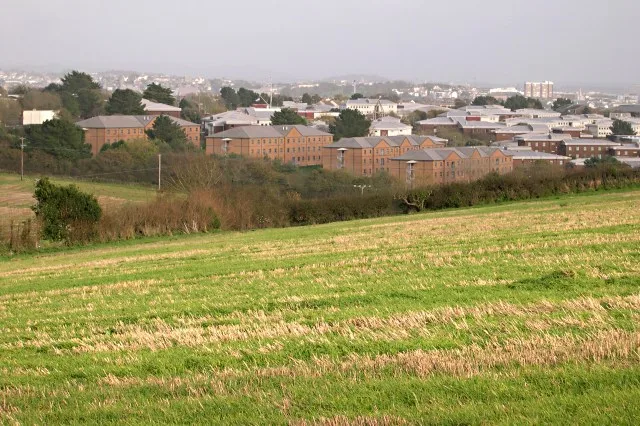 HMS Raleigh, Torpoint, from the west, 2005.
Photo: Tony Atkin, CC BY-SA 2.0, via Wikimedia Commons.

At Raleigh the school trained officers and ratings in weapons engineering and warfare, from their first professional courses to later career courses. The basic qualification changed too: by 2002 the old Part III had become Submarine Qualification, a dry phase ashore and a wet phase at sea, and the dry phase was taught at Devonport and on the Clyde. In 2012 the school became the first Armed Forces training school recognised as an approved centre for qualifications regulated by Ofqual. In 2014 its 58 instructors were training around 160 submariners every week, and it still helped with Perisher.
Women joined the Submarine Service after an announcement on 8th December 2011. On 5th May 2014 Lieutenants Maxine Stiles, Alex Olsson and Penny Thackray became the first women to earn their Dolphins, in HMS Vigilant.
A New Home on the Clyde
Submarine training is now moving to the Royal Navy Submarine Training Centre at His Majesty's Naval Base Clyde, known as the Dolphin Building, so the name passes to a third home. The building was complete by April 2025, and on 16th February 2026 a class of 39 Submarine Qualification students passed out of their dry phase there. It will also train the crews of the Dreadnought class.